- Open Source CEO by Bill Kerr
- Posts
- The Ultimate Founder Mental Health Stack
The Ultimate Founder Mental Health Stack
Psychedelics, depression drugs, dog walks, training, meditation, Whoop and loads more. 💆🏻♂️

Bill Kerr
April 24, 2026
👋 Howdy to the 4,324 new legends who joined since our last edition! You are now part of a 393,591 strong tribe outperforming the competition together.
LATEST POSTS 📚
If you’re new, not yet a subscriber, or just plain missed it, here are some of our recent editions.
🔥 The CFO Who Killed The Spreadsheet. An interview with John Glasgow, CEO & CFO at Campfire.
🧊 Get Down On Your Knees And Pray For Shackleton. The greatest Antarctic adventurer and how to lead through difficult times.
⚡️ Data Is King & AI Is Queen. An interview with Bryan McCann, Co-Founder at You.com.

PARTNERS 💫

Framer helps teams design, build, and launch their marketing sites lightning fast. With the ability to publish hundreds of CMS pages in a single click, operate at a global scale with seamless localization, and even host unified content across multiple domains, teams have never been able to ship faster.
Trusted by companies like Miro, Bilt, and Perplexity.
The biggest win from the 5 Day Challenge isn’t finishing everything.
It’s leaving with clarity: knowing how HighLevel fits your goals and where to take it next.
Missed this session? Join the next one!
Interested in sponsoring these emails? See our partnership options here.

HOUSEKEEPING 📨
Considering today’s piece is around mental health, I thought it would be cool to use this news as the anchor for my housekeeping section this week. It fills me with positivity and hope for the future when I see leadership like this. Phones are like cigarettes.
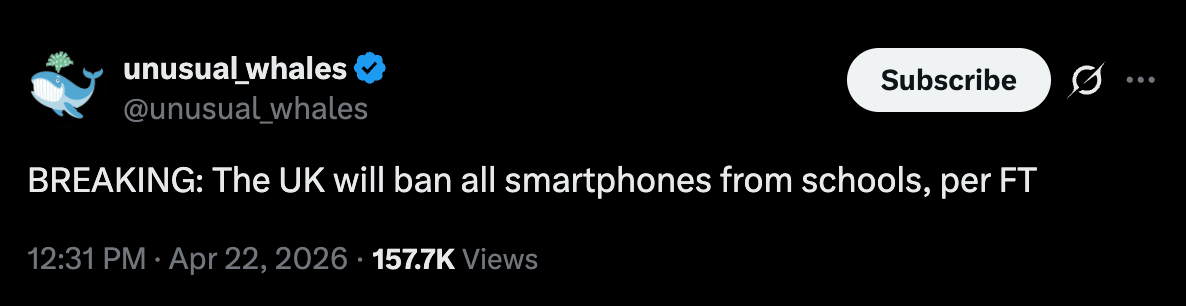
We all know this to be true, so the sooner we can eradicate them from our lives, the better. I predicted a few years ago that, in a decade, phones would exist but be a low-status toy. We can only hope!

BUILDING IN PUBLIC 🔎
The Ultimate Founder Mental Health Stack
Being a founder is tough. Being a founder and maintaining your personal wellness is tougher. And being a long-term founder without taking an above-average amount of knocks to the self-esteem, happiness, and mental health zones inside of your head, well, that’s near impossible.
But the good news is, there are things you can do. With the right amount of support, effort, and empathy, any founder can live a happy and healthy life.

If you are a founder, or anyone for that matter, who is currently going through a rough period, today’s piece is not the answer to your problems. What it is, though, is an unfiltered, no-holds-barred look into the life of one founder, me, and what I have done successfully and not-so-successfully in the past.
If nothing else, I aim for this post to be fun, encouraging, and most of all, a love letter to all the crazy ones out there, just to tell you one thing—that you are not alone.
A quick foray into the data
We know anecdotally that founders go through periods of hell, but what does the data tell us about this? One 2015 study by Michael Freeman titled ‘Are entrepreneurs touched by fire?’ attempts to answer the question.
In this study, 242 entrepreneurs and 93 demographically matched comparison participants completed an anonymous, online, self-reported survey to assess their engagement in entrepreneurship and their individual and family mental health histories. The findings were pretty stark.
Self-reported mental health concerns were present across 72% of the entrepreneurs in this sample, a proportion that was significantly higher than that of the comparison group.
The entrepreneurs were significantly more likely to report a lifetime history of depression (30%), ADHD (29%), substance use conditions (12%) and bipolar diagnosis (11%) than were comparison participants.
  |   |
*Note: All data was sourced from Michael Freeman’s study.
Not only did the studies show a much higher risk of ADHD, anxiety, and depression, but there was a correlation between entrepreneurship and the ultimate sadness, suicidality. As someone who has lost a close family member to suicide, I have always had a very strong pull towards trying to understand mental health and how to cope successfully as a founder.
My backstory
I grew up in a very small town with a relatively happy family. School was amazing. I was the class clown and the best footballer in the area, so growing up, I felt somewhat as if I were the center of the universe and could do no wrong.
That did change briefly when I had a health scare in my twenty-third year, but even that spurred a positive change in me, opening my eyes to how quickly life can change and leading me to take off across the world with a backpack on my back.
 Me on the left. |  Also, I'm on the left. |
 Bolivia. |  Iguazu. |  Zimbabwe. |
This long, unbroken streak of life-is-good-ness lasted until around 2014. I was 28, had come back from my travels, and had just taken the step of moving to the city and starting my first startup, AdventureFit. The brand was beautiful, the experience was second to none, but we really never made any money. Around three years into AdventureFit, with the writing on the wall that the company wasn’t going to work, a mentor told me that I was “the most driven founder he’d ever seen in 25 years of business coaching.”
He followed this up by telling me that, in this particular case, that was not a good thing. “You need to know when to quit,” he told me. This was a skill I was yet to learn, and I suffered for it.
Personal debt, insane stress, sleeping on my own couch to rent out my bed for long periods at a time. It came to a head at my best friend’s wedding when my anxiety and stress had peaked so aggressively that instead of enjoying the final day of the destination wedding, I decided I needed to lock myself in a hotel room for the entire day. |  Wedding night. |
People couldn’t understand it. I was gregarious, confident, outgoing, and just the night before, I had done a cracking job as best man at the wedding. But I was mentally broken from stress. It wasn’t until I had a text exchange with another friend that it really clicked what was going on. I had been telling him how stressed I was, how I felt a little bit sad all day for no reason, and that I had this really weird sort of heartbreak feeling.
As someone who had had his own mental health battles, he replied with a simple line that I’ll never forget reading: “Yep, that’s called depression, mate.”
Things I’ve tried in the past
After I realized I had depression, the task was to get rid of it, or at the very least, learn to manage it. Which I have done successfully and unsuccessfully over time. Here is a snapshot of some of the things I have done and how I found them.
Daily meditation: Thanks to the rise of wellness, the discussions and destigmatization around mental health, and my general openness to new things, I dove heavily into meditation. Sam Harris became my guru, and I devoured anything and everything about meditation.
The good news is, I think meditation is great. I feel more relaxed when I meditate, and I did it 4-5 times per week for years. However, I do not meditate right now, and I didn’t find much efficacy in countering my depression. Having said that, I didn’t have a control group of me’s that were not meditating during the same period, so it’s somewhat hard to really know.Cold showers, ice baths, Wim Hof breathwork: Next up, I found the trend of cold showering, ice baths, and breathwork, partly thanks to the rise of Wim Hof, and gave that a shot for a long while as well.
I never went deep into the breathwork side, although I dabbled, but I did have a cold shower every morning for a long time. It’s something that I’d love to pick up again, to be honest. Not really for mental health, but just because it gives you a very invigorating feeling and is great for overall health, mood, circulation, etc.
*Below is an interview I did with Wim Hof nearly 10 years ago.
Journaling, gratitude, and general: Next was journaling. We have all heard the studies about how much gratitude journaling increases overall wellness. And it makes sense. The best way I had it explained to me was that ‘Happiness is momentum, the more pleasant, empathetic, and positive thoughts you can have, the deeper the neural pathways become, the easier it is to keep skiing down those wellnessy slopes.’
I have no idea who told me that, and I know they didn’t phrase it in exactly that way, but you get my drift. I no longer have a gratitudinal (actual word) practice today.
Psychedelic and clinical experiences
Psychology and Cognitive Behavioral Therapy: While I was in Australia and for most of the last decade, I have had a consistent, albeit somewhat stop-and-start, relationship with my psychologist. I’ve learned a lot over the journey and do value having someone to talk to. Mainly to understand the brain in general, rather than my brain per se.
Ketamine assisted therapy: In early 2022, when I was really struggling and had just left Australia, I heard the founder of Field Trip Health interviewed by Professor Scott Galloway about the benefits of ketamine-assisted therapy in reducing the effects of otherwise treatment-resistant depression.
Although psilocybin had not been approved by the FDA in the U.S., the treatment was available, and I was about to land in the U.S. With only a few days before heading further south, I was able to secure a six-session course of treatment over a month at their San Diego clinic.
The treatment itself cost me close to $10k, plus the additional time spent staying in an Airbnb in San Diego, but it was worth a roll of the dice. The experience itself was quite wonderful. You are given a doctor and a psychologist. The doctor will be the one who recommends how much ketamine to pump into your system every session—50mg to start, and up to 120mg to finish for me—and the psychologist is the one who will walk you through the journey.
I could not speak more highly of my time at Field Trip, and although the experiences were challenging, it was definitely worthwhile. Months later, my partner said she had seen a huge improvement in my overall mental health, and she was probably right.

 |
Psilocybin (magic mushrooms): Out of respect for the sponsors of today’s post, I will leave this section out for now, as experiences I may or may not have had were not done in a way I feel right expressing.
Ayahuasca in the Amazon: Unfortunately, following on from some positive effects of the ketamine therapy, and some shiny new medication, I still hadn’t been able to get into a good place, so in mid-2023, I did something that has been top of mind for me for close to a decade; I booked a week-long Ayahuasca retreat in the jungles of Peru. This was what I could only explain as a weeklong waking nightmare.
I walked into the center with 22 or 23 other travelers, all there for one reason or another: lost loved ones, retrenchment, a general feeling of being lost in life, etc. And although I felt like I was walking in with a relatively good outlook on life, I walked out of there 10 times more mentally shattered than when I entered. This was very disappointing and hard to come to grips with. It probably took me three months to fully recover to my baseline, which was depression.
Why was it so difficult? Well, I have had what you would call a ‘Hero’s Dose’ of other psychedelics in the past, and when quite deep during my ketamine experience, but ayahuasca is something unto itself. And if you are on the wrong end of a deep ayahuasca experience—which I was on each and every one of the ceremonies—you are in for a night of hell. I spent the majority of the week thinking I was going insane or thinking much worse things than that. I felt like, for whatever reason, the experience was very counterproductive for me.
There was also the fact that each ceremony started at 8pm and sometimes lasted until 4am, with breakfast three hours later. I feel like people were irritable and exhausted due to the sleep deprivation they went through during the week. The experience cost around $5k when you add up the program, flights, etc.

Jungle.
Brain scans at Amen Clinic: Following my trip to the jungle, I sought help from the Amen Clinic, a professional brain care clinic in the U.S. I wanted to assess the overall health of my brain because I had a sneaking suspicion all of my problems stemmed from an unsuccessful backflip-on-a-dancefloor attempt I made when I was 28. The attempt left me unconscious, soiling my pants, and unresponsive for a total of 43 minutes. As I was rushed to the hospital in an ambulance, the doctors called my parents to tell them I was suspected of having brain damage and spinal injury.
The results gave me good news, irrelevant news, and bad news. The good news was that my brain was in incredible good condition for a 37-year-old. The irrelevant news was that it showed signs of chronic depression and anxiety. The bad news was that I was still searching for answers.
*Note: In case you were wondering, that was my one and only backflip attempt in this lifetime. Officially retired from drunken gymnastics.
 My brain on depression. |  My brain on anxiety. |
BONUS: Ezra cancer scans: Around this time, I decided to drop by for a scan at Ezra, a clinic that has a tagline that reads, “We found cancer’s greatest weakness—early detection.” I thought now that I am getting older, I should start proactively looking after not only my mental health but my physical health too.
Two weeks after the scan, I was told that I had a 6 cm tumor in my lungs. It took four weeks, multiple specialists, a three-day stint in a German hospital (oh yeah, we were on holiday), a bronchoscopy, and a biopsy for them to tell me that ‘there was nothing to worry about.’
Ezra is awesome, I think. If you can get ahead of a scary diagnosis like the big C, it can and will save your life. But I’ve also heard mixed reports of the efficacy of the scans and lots of people like me who basically had a bad flu going through hell to find they were actually fit as a fiddle. I guess the stress is worth it; cancer is preventable, in a way, if you catch it early. (shrug) The scan itself costs around $3k and is recommended annually or biannually.
 The report. |  The diagnosis. |
My recent and/or current stack
Phew, man, that last section was kinda heavy. Before I dive into the things I am doing right now to live a happy and healthy life, I want to take a moment to tell you that I actually don’t feel like I have depression today. I still have massive bouts of social anxiety, and I bail on a lot of things, but I actually feel pretty good overall.
Let’s take a quick look at how and why I can say that, considering everything you just read.
Desvenlafaxina (depression meds): Well, for starters, I am on medication. For the longest time, all the way up until last year, I stayed away from medication. There was one small period in which I was on meds, but my grandpa took his own life after his lifelong medication was discontinued and then changed on him at ~70 years old.
Plus, add to the fact that every study under the sun will show you that meds are about as efficacious as improving sleep, exercising once or twice a week, etc. But anyway, I am on them, and they seem to be ok.Brain care pills and GABA: I say brain care pills and GABA, even though they are one and the same, because I want to really make a highlight of the GABA part. GABA, or Gamma-Aminobutyric Acid, seems to be an incredibly successful way for me to be able to really take the edge off my anxiety.
I mainly get anxiety in social situations, nothing else really. It’s the reason I love writing but hate podcasting. Podcasting just stresses me out. In my younger days, I would pull the rower down in my bedroom—yes, I had a rowing machine in my bedroom—and bang out 5km or some 500m sprints to try to blow out the anxiety cobwebs. Today, because I am sin / sans the bedroom rower, I use GABA.
I also use a combination of personally recommended cerebral supplements from my work at the Amen Clinic. Every morning, midday, and evening, I have a combination of saffron, GABA, omega-3, and more.

The good gear.
Sport, competition, weightlifting: For me, I have been very active—training and sport-wise—basically all my life. First, it was Aussie rules football, then CrossFit for a split second, then weightlifting. The last thing I competed in properly was weightlifting, lifting at the 2016 National Championships as an 85 kg lifter.
I feel happier when I have a goal and something to work towards. In 2016, my goal, even though I started weightlifting at 28, was to represent Australia. It was going to be hard because they don’t usually give spots to people who don’t have a long runway in the sport, unless you are the best in the country.
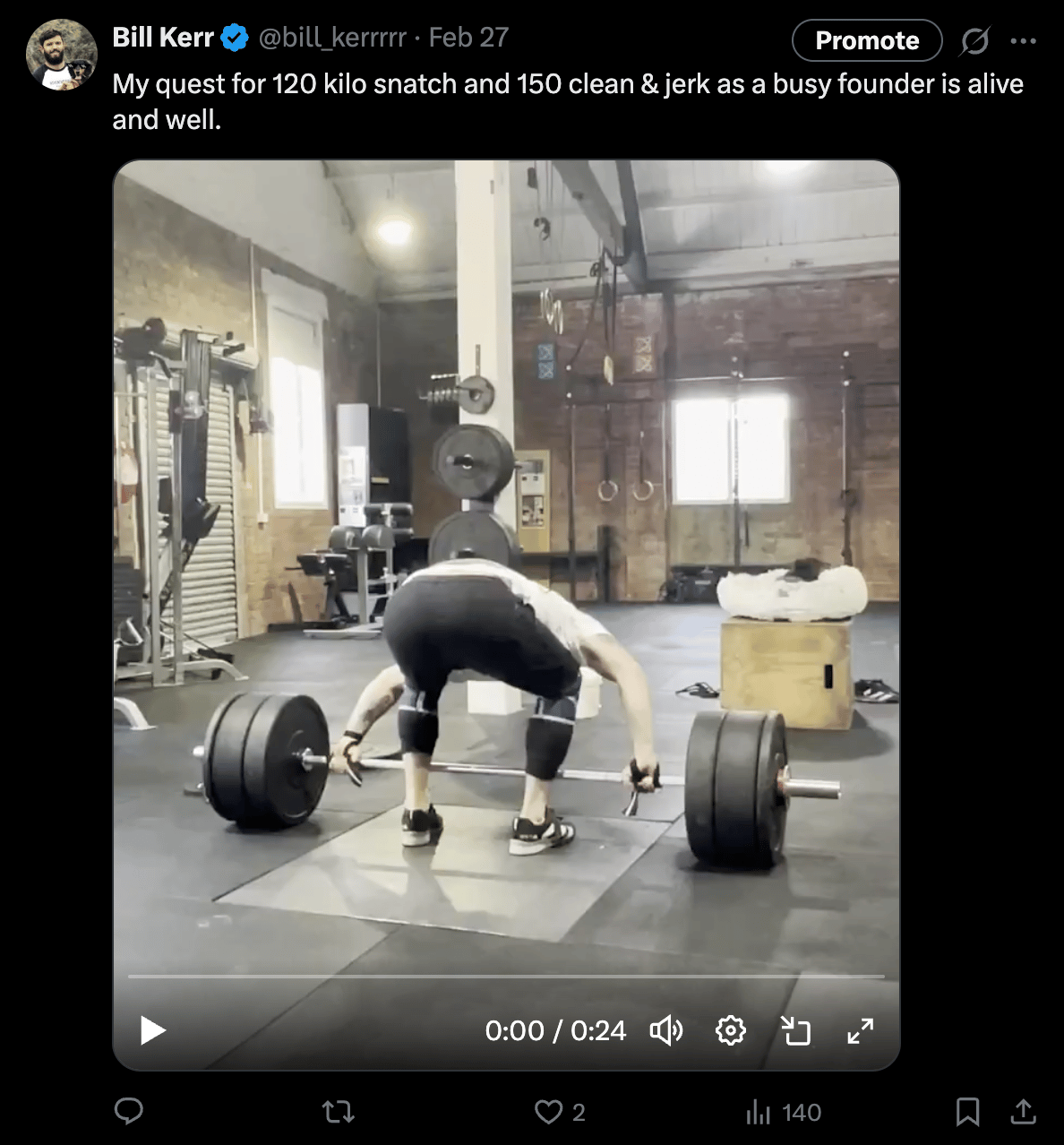
Funny thing was, after the 2016 comp, I gave myself the following week off, and then that extended to a fortnight, then a month. And then I didn’t really train hard again, aside from a quick dash into powerlifting, until last year. Now I have a new goal. My lifetime goal is back on, training towards a 120 kg snatch and a 150 kg clean and jerk. And my looser, funner goal is to be the internet’s strongest startup founder.
Whoop, Eight Sleep, outlet timer: One thing I love right now is my Whoop. It helps me track my training, my recovery, and most of all, my sleep. I also have an Eight Sleep bed, which is supposed to improve my sleep, but we hardly even use it, really. No shade on Eight Sleep, they’re cool, we’ve just not really seen the benefits.
Whoop, on the other hand, I live and breathe. Another small change that has positively impacted our lives is installing an outlet timer on our modem. At 10pm every single night, our internet cuts off. And yes, we turn it back on from time to time, but most of the time we do not.
A phenomenal way to force a habit of getting off the devices, Netflix, and so forth early and prepping for a consistent bedtime.No socials, no SIM card. I think it’s been nearly three years now that I have been without a SIM card, and much longer, maybe 4-5 years, since I have had any social media on my phone.
My long-term plan was to throw my phone in the bin and just use the Apple Watch, but unfortunately, it’s actually impossible. You can have the phone and just store it away, but you can’t just live without one. Which is kinda shit.
I really just want an Apple Watch for podcasts and audiobooks, as I’d be heartbroken without them. I invested in Humane, which ended up a total flop, mainly because I believed in their mission of ridding the world of the scourge of our time, the smartphone. I think it’s coming, a world without phones, but it may still be some time yet.
Working with a dietician and a chef: My partner and I both started working with a dietician recently, and it’s been quite good. I am now pretty diligently tracking my body fat, lean muscle, etc., for the first time ever, and I am really enjoying it. I started at 22% body fat, which isn't super high, but I got it down to 18% pretty quickly.
We also pay for a cook to come and prepare our meals for us every so often now. Granted, we were doing this ourselves, but we do it every fortnight just to free up Sunday a bit and because it’s quite economically feasible in Argentina, where we are currently living.Weekly breakfasts: I still struggle a fair bit socially and pull out of a lot of things, and weirdly, once it gets past 4pm, the chances I’ll bail on something go through the roof. So I do breakfasts. On Wednesdays and Fridays, I catch up with a couple of Athyna team members from different departments.
We spend very little, sometimes zero time, speaking about work. It’s just a great way for me to spend some time with people, and especially with the team in a less formal space. I really love it.
 Legends. |  More legends. |
And most importantly, my partner and my dog: And it goes without saying, the most important part of your mental health stack should be your closest partners in crime. Your loved ones. For me, that would be my partner, Taina, and my dog, Ziggy.

LOL at Ziggy.
Things I want to try
And lastly, for the sake of it, here is a short list of things I think I would like to try in the not-too-distant future to hopefully be happier and healthier again.
More co-working time: Before COVID, I worked remotely, just like I do now, but I probably went into my co-work 2-3 days per week. Today, I probably go in 0.2 times per week. Once every 5 weeks, maybe less. Granted, I work from home, and Taina and Ziggy are around, but it’s still nice to get out and say hi to some new people, be around some energy, etc.
Serious gut health work: And the one major stone I have left somewhat unturned is my gut health. I did a program for a few months some years ago, but I left feeling like there was a lot more work to do. And the more research that we do, the more it seems that the gut-to-brain link is hugely important to the creation of serotonin. I do plan to dive heavily into this at some point in the not-too-distant future.
Summary
Well, that was quite the experience diving into all of that with you. If nothing else, I hope this mental-health-in-public type post reminded you that we all go through ups and downs. And especially those of us who are ambitious and/or stupid enough to try to take on the world through entrepreneurship. |  New Zealand. |
Extra reading
Waking Up, Sam Harris - September, 2014
Tribe, Sebastian Junger - May, 2016
Lost Connections, Johann Hari - January, 2018
How To Change Your Mind, Michael Pollan - May, 2018
And that's it! You can follow me on Twitter and LinkedIn, and also don’t forget to check out Athyna while you’re at it.
BRAIN FOOD 🧠
TOOLS WE RECOMMEND 🛠️
Every week, we highlight tools we like and those we actually use inside our business and give them an honest review. Today, we are highlighting Granola*—an AI-powered notepad that takes, summarizes, and organizes meeting notes without using intrusive recording bots.

See the full set of tools we use inside of Athyna & Open Source CEO here.
HOW I CAN HELP 🥳
P.S. Want to work together?
Hiring global talent: If you’re hiring tech, business or ops talent and want to do it 80% less, check out my startup, Athyna. 🌏
See my tech stack: Find our suite of tools & resources for both this newsletter and Athyna here. 🧰
Reach an audience of tech leaders: Advertise with us if you want to get in front of founders, investors and leaders in tech. 👀
 |
Reply