- Open Source CEO by Bill Kerr
- Posts
- From eBay To Scaling Language AI
From eBay To Scaling Language AI
An interview with Bryan Murphy, CEO at Smartling. 🏭

Bill Kerr
January 22, 2026
👋 Howdy to the 1,893 new legends who joined this week! You are now part of a 240,495 strong tribe outperforming the competition together.
LATEST POSTS 📚
If you’re new, not yet a subscriber, or just plain missed it, here are some of our recent editions.
🫠 Getting To Know Me: Sliding Doors. A little bit about, presented by, well, you guessed it, me.
📌 Unfiltered: How Do Chiefs Of Staff Measure Success? Chiefs of staff give us the juicy inside scoop on their success criteria.
🫡 So, What Does A Chief Of Staff Actually Do? The Pandora's Box of startup roles. We deep dive into the Chief of Staff.

PARTNERS 💫

Attio is the AI-native CRM for your team. Connect your email and calendar, and Attio instantly builds a CRM that matches your business model—with all your companies, contacts, and interactions enriched with actionable insights.
With Attio, AI isn’t just a feature—it’s the foundation. You can do things like:
Instantly prospect and route leads with research agents
Get real-time insights from AI during customer conversations
And build powerful AI automations for your most complex workflows
Industry leaders like Taskrabbit, Granola, Flatfile, and more are already experiencing what’s next.

Framer is the design-first, no-code website builder that lets anyone ship a production-ready site in minutes. Whether you're starting with a template or a blank canvas, Framer gives you total creative control with no coding required.
Add animations, localise with one click, and collaborate in real-time with your whole team. You can even A/B test and track clicks with built-in analytics.
Interested in sponsoring these emails? See our partnership options here.

HOUSEKEEPING 📨
If you missed this Sunday’s debut episode of A Knight of the Seven Kindoms, then you missed a real treat. As someone who has read A Song of Ice & Fire (Game of Thrones books) three times through, along with every one of the prequel and history books, I can say that I love these books, and absolutely loved the first episode of the show. The casting of the main characters, Dunk and Egg, could not be better.

The best cast characters, true to the original books IMO, were Sir Davos, Charles Dance as Tywin Lannister—except in the books he was bald with mutton chops—and obviously Peter Dinklage as Tyrion. The casting of Dunk and Egg trump them all. If you are in for a good faith frolic through Westeros, this show is for you. Oh, and by the way…
Would you read an episode summary of Knight of the Seven Kingdoms (by me) per week? |
Not sure why, but I have always wanted to create a Game of Thrones newsletter. This would be the next best thing. Anyway, enjoy today’s piece with Bryan!

INTERVIEW 🎙️
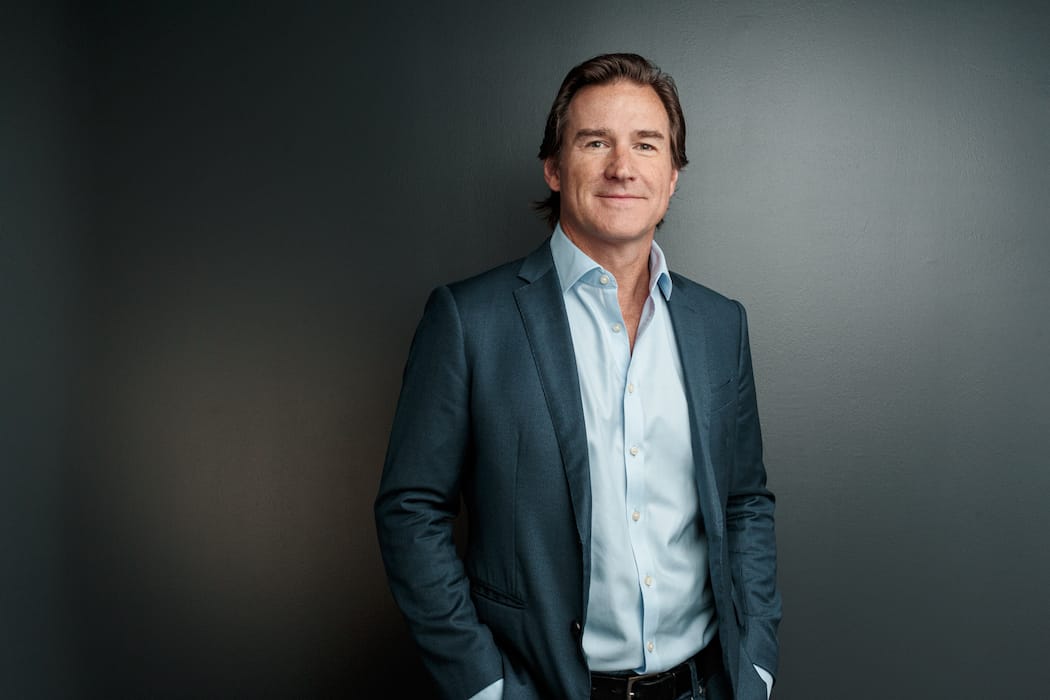
Bryan Murphy, CEO at Smartling
Bryan Murphy is the CEO of Smartling, the enterprise Language AI company used by global brands to create multilingual customer experiences. He was appointed CEO in April 2022 following a $160 million dollar growth investment, with a remit to expand Smartling’s enterprise-grade translation platform and accelerate its AI roadmap. Under his leadership, it has emphasized automation, model choice, and secure use of proprietary training data to improve translation quality and speed for large enterprises.
Before Smartling, Murphy built and led at the intersection of software and commerce. He co-founded and served as CEO of WHI Solutions, a SaaS company acquired by eBay, where he later became vice president of vertical markets and previously led eBay Motors. He has also held senior roles across e-commerce and SaaS, including leadership positions at Breather and Serta Simmons, and he frequently speaks on the ROI of AI in localization.

Bry guy, my guy.
Tell us about your time at eBay and building that business?
I spent almost four years at eBay. eBay acquired my company, WHI, and I came in with the opportunity to run eBay Motors, which was an eight billion dollar a year business selling used cars and auto parts. I spent a few years on that, then picked up additional businesses as I went. By the time I left, I was vice president of vertical markets, responsible for eBay Motors, eBay Fashion, art and collectibles, daily deals, and more. I owned those businesses from both a product and a global strategy perspective.
What problem is Smartling solving right now?
Smartling helps global companies communicate with their customers in their own language, which is one of the most powerful forms of personalization. Think about it: marketers spend huge amounts of time crafting content that speaks to specific audiences, but if that content isn’t in the customer’s language, all that personalization is lost.
Our platform helps enterprises like Apple, Disney, IBM, Tesla, and Pepsi translate and localize their content quickly, accurately, and at scale. The traditional translation process has always been slow, cumbersome, and expensive. Smartling solves that with AI-powered translation. |
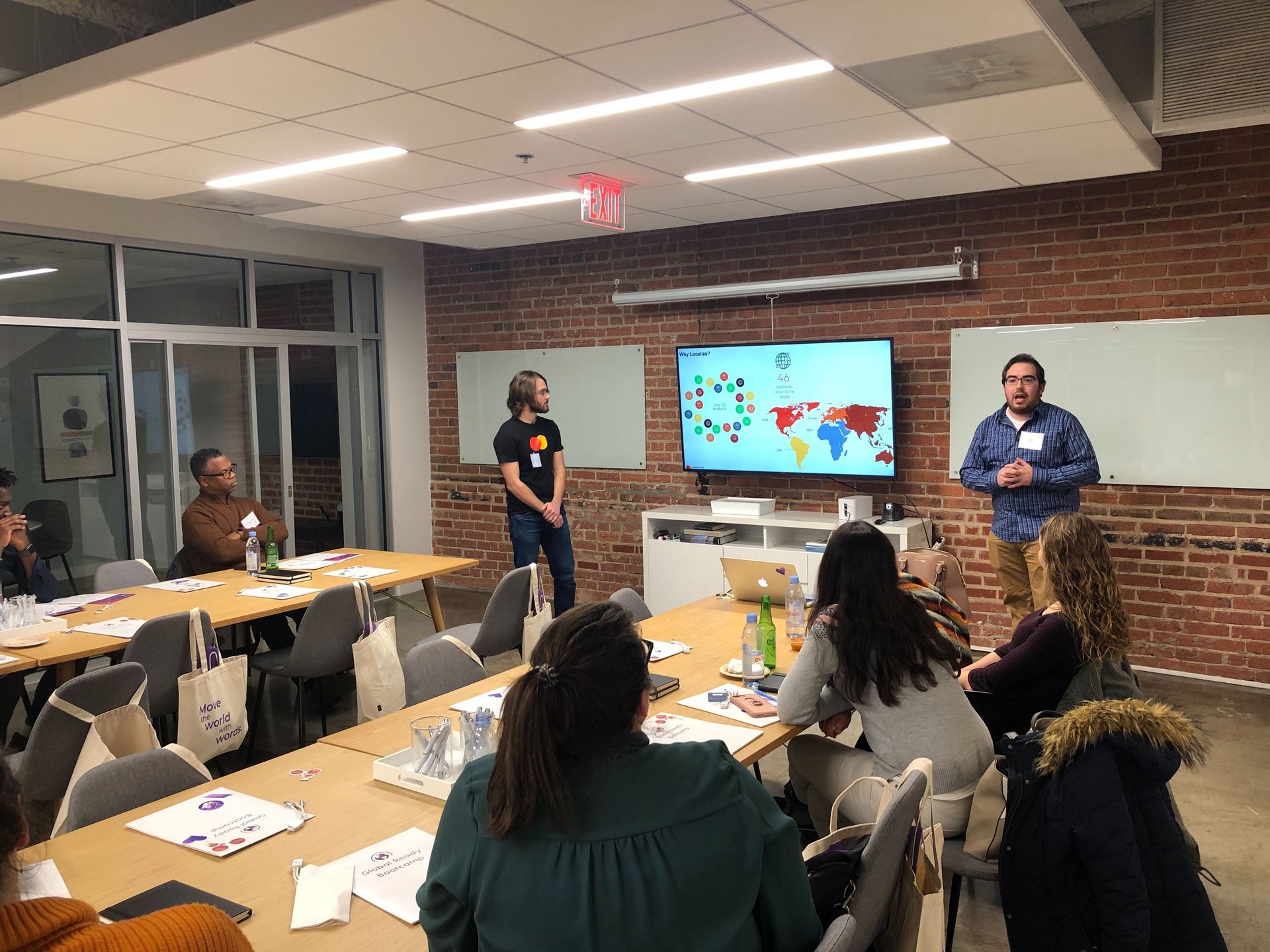
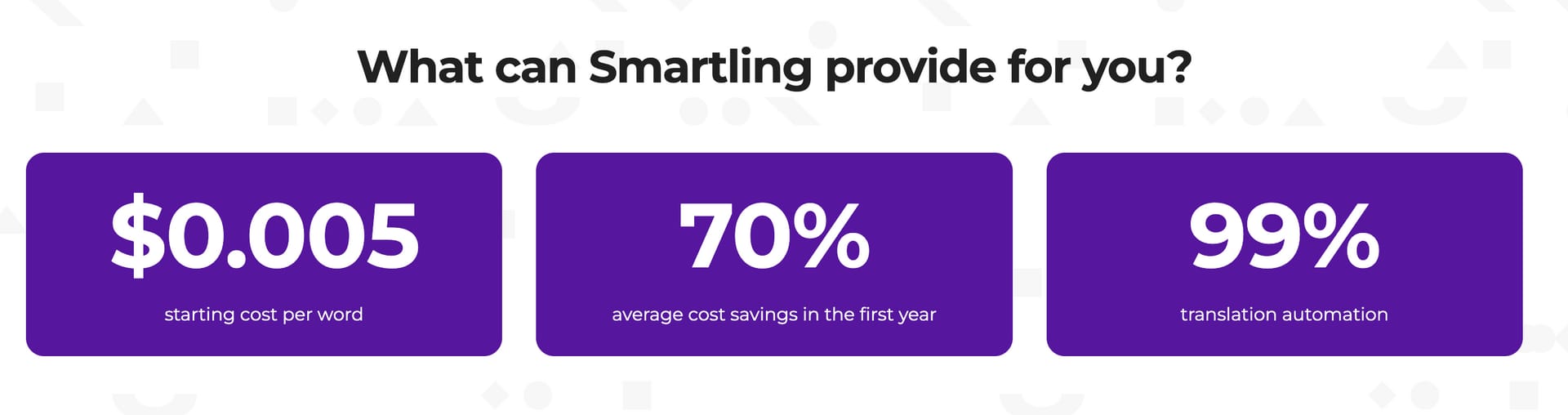
We integrate directly into a company’s tech stack so that about 99 percent of their content is automatically translated.
We use AI to handle the bulk of the work, with the option for a human in the loop when needed. This approach delivers translations up to four times faster and at roughly 60 percent less cost. It’s faster, higher quality, and far more efficient, essentially transforming how global communication happens.
Before the LLM boom, were you already building with AI or did you adapt an existing approach?
Yes, we were already building with AI before the large language model boom. One of the things that attracted me to Smartling when I joined four years ago was its deep foundation in both cloud-native software and the original wave of AI: machine learning and neural machine translation.
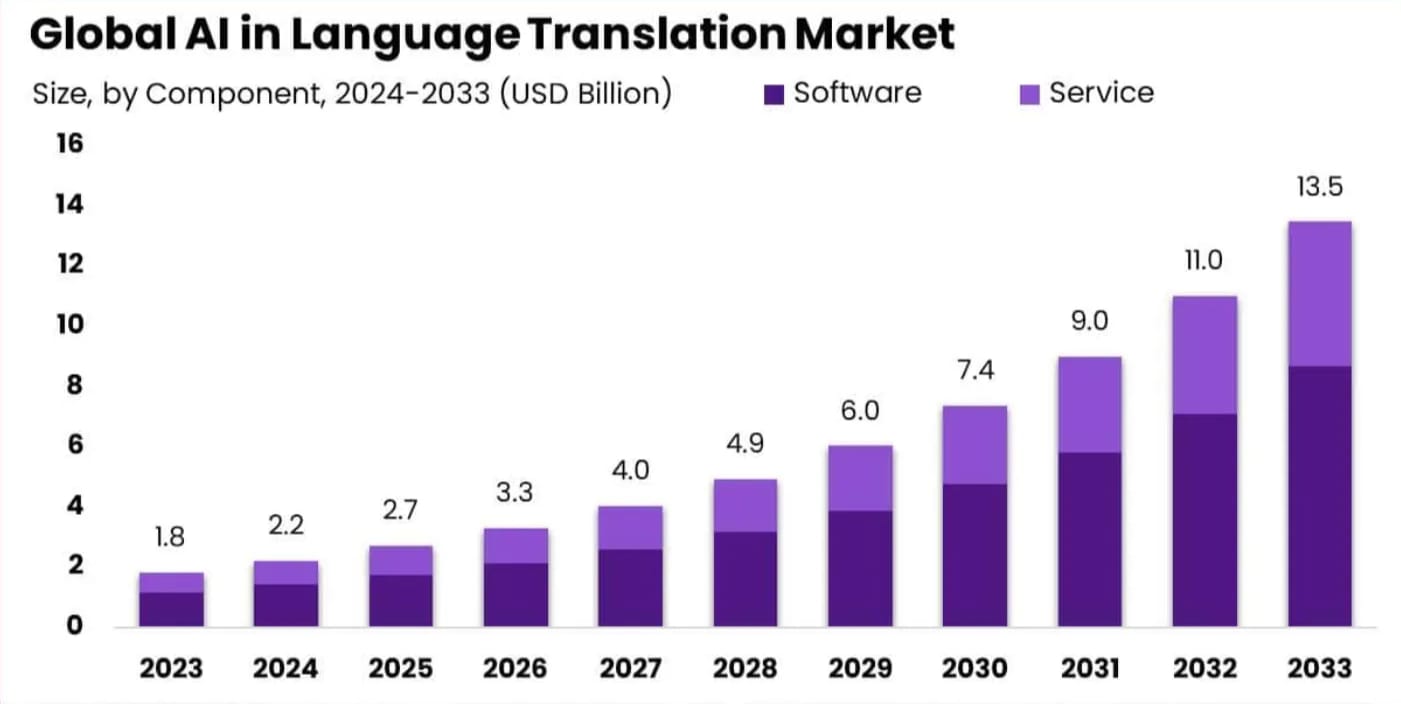
Source: Market.us.
Neural machine translation was one of the earliest real applications of AI, so when large language models appeared, we immediately understood their potential. We already knew how to work with these technologies and had a clear vision for how to integrate them into what we were doing. It wasn’t a total pivot—it was a natural evolution of the expertise we’d been building for years.
You were brought in to pivot the company toward AI. How did that go?
It was hard but incredibly interesting. When ChatGPT first launched, I remember getting up that weekend, grabbing a cup of coffee, logging in, and realizing immediately how massive the impact would be on translation and localization. I started messaging my leadership team right away and told them we needed to talk Monday morning.
That Monday, we basically threw out our entire operating plan and product roadmap to focus on this new opportunity. It was a big bet, but the team already had deep experience in machine learning, so everyone understood what was at stake. Still, change is never easy.
The toughest part was reorganizing our technology, engineering, and R&D functions to move faster and adopt the new technology effectively. We created a dedicated R&D team focused on testing hypotheses quickly. If an experiment hit a certain confidence level, it would move to product, then to engineering for production. If it didn’t, it was cut. No endless spin cycles.
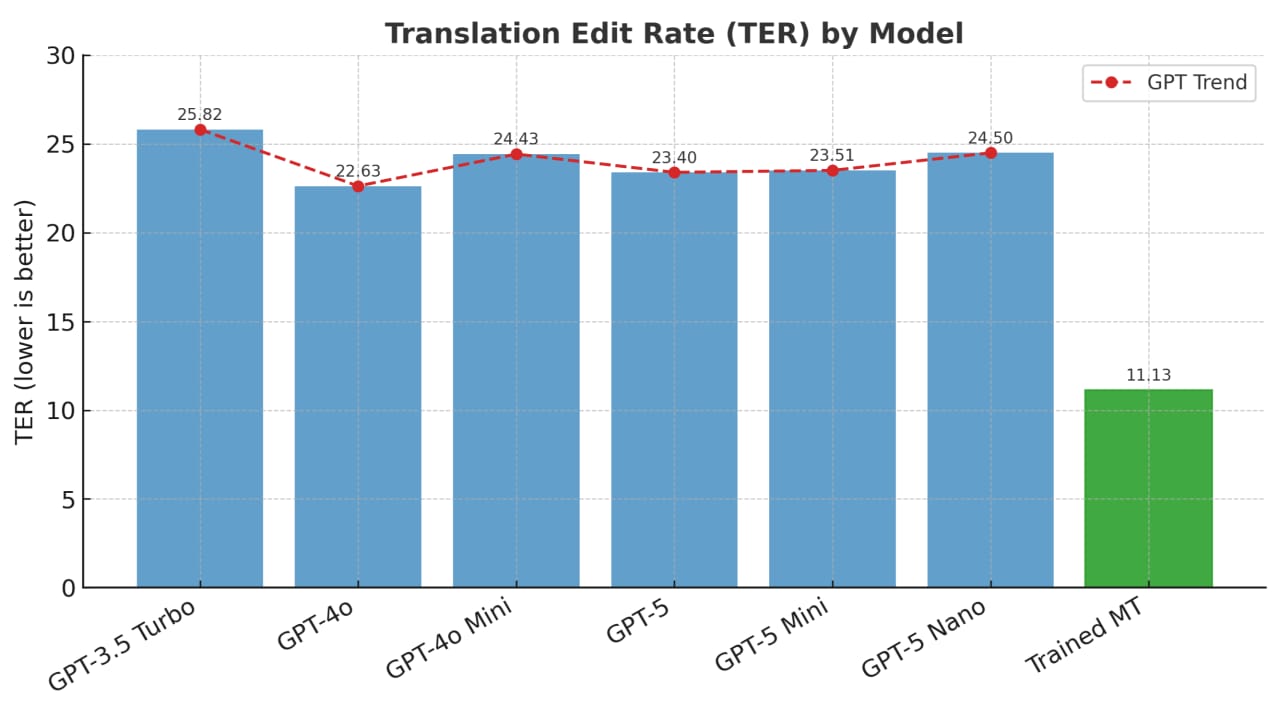
That structure gave us incredible speed. Our engineering and product teams now push about 3,300 production releases a year, which is a huge competitive advantage. It allows us to innovate much faster than others who might release just a few times a year.
The other big challenge was helping customers understand the reality of AI adoption. Many executives see AI tools as ‘free magic’ because they can type something into ChatGPT and get an instant result. But building an enterprise-grade AI application is extremely complex and expensive. Part of our job has been to educate customers and help them bring AI into their organizations in a practical, secure, and truly valuable way.
What is your main day-to-day job as CEO?
I like to start by saying that everything is my fault. I mean that both jokingly and seriously, because ultimately, the responsibility for how things go rests on my shoulders. My main job is to work with our stakeholders—our board, customers, and employees—to define our strategy and ensure we execute it effectively.
That means setting both our long-term and short-term operating strategies and then ensuring the entire company is aligned around them.
I also spend a lot of time talking with customers. I believe strongly in what Jeff Bezos called ‘the empty chair’ idea, keeping the customer present in every discussion. I do that both literally and virtually by staying in close contact with clients and with my team. | 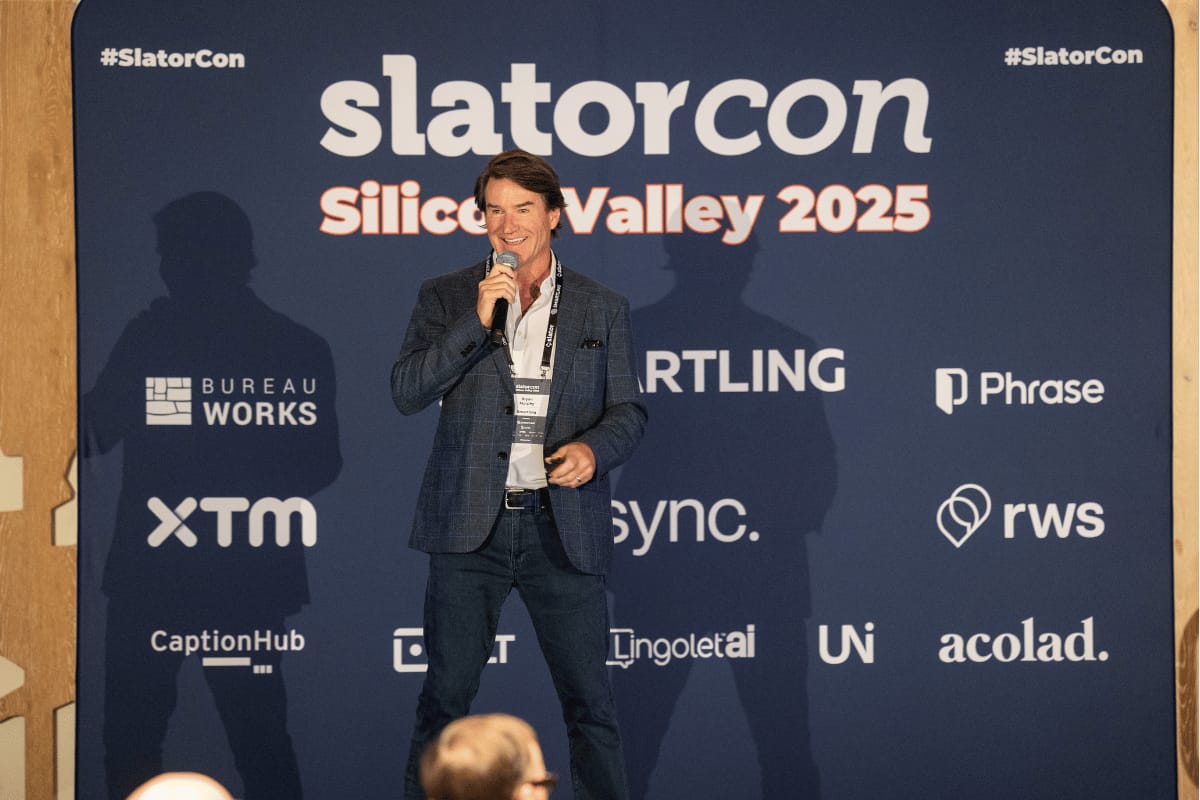 |
Most of my time goes into making sure we’re focused on the right goals, staying accountable, and executing with consistency.
What does your team look like, and who are your direct reports?
My leadership team includes our CFO, Chief Revenue Officer, Chief Customer Officer, Head of Engineering, Head of Product, Head of R&D, and the leader of our language and translation business.
Each of them oversees a critical function: finance, revenue generation, customer success, technology, innovation, and linguistic operations. Together, they form a well-balanced team that keeps Smartling moving quickly and aligned across all parts of the business. | 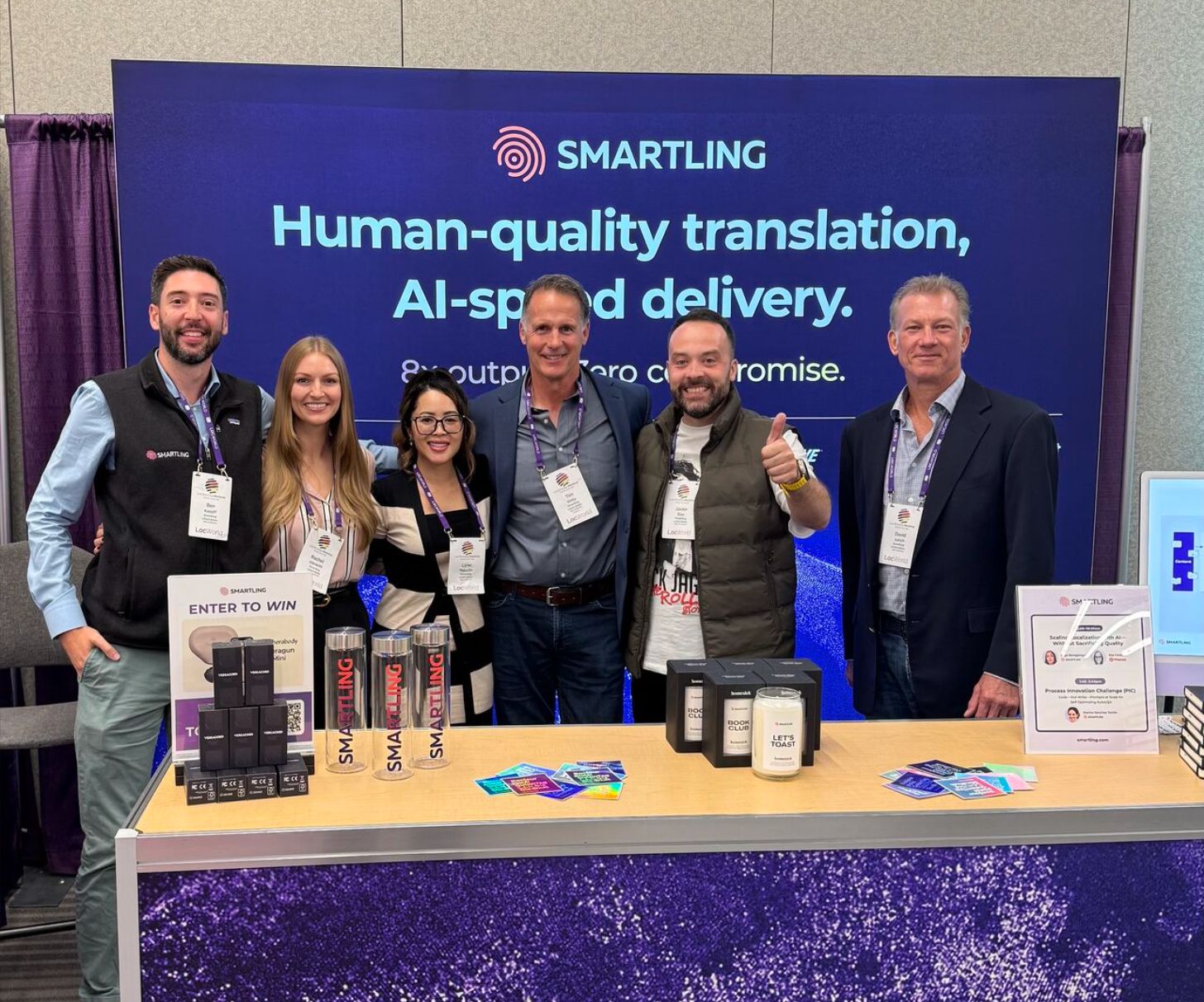 What a team! |
How do you hire all-star talent?
Hiring great people is the toughest and most important part of the job. Fortunately, we have a strong advantage because Smartling is in such an exciting space. AI-powered translation is a thirty-billion-dollar global industry, and it’s one of the three main areas where AI is having a massive impact, along with coding and content creation.
When we talk to candidates, it’s easy to get them excited about what we’re doing: offering translations that are four times faster, 60% cheaper, and higher quality than traditional methods. The opportunity itself attracts high performers.

At the senior level, we lean heavily on our network and our investors, like Battery Ventures, which has a deep pool of talent across the industry. From there, we rely on word of mouth and referrals. We reach out to people in our circles and say, “Who’s the best engineer or computational linguist you know?” That personal approach helps us find exceptional people and get them genuinely excited about joining Smartling.
How are you using AI in your daily operations?
We partner with all the major AI providers—IBM, Google, OpenAI, and Anthropic. They supply the core ‘engines’ that power our platform. For each customer, we build a custom engine by combining multiple models and training them with the company’s own linguistic assets, such as translation memories, glossaries, style guides, and tone of voice. That’s how we deliver high-quality, on-brand translations so quickly.
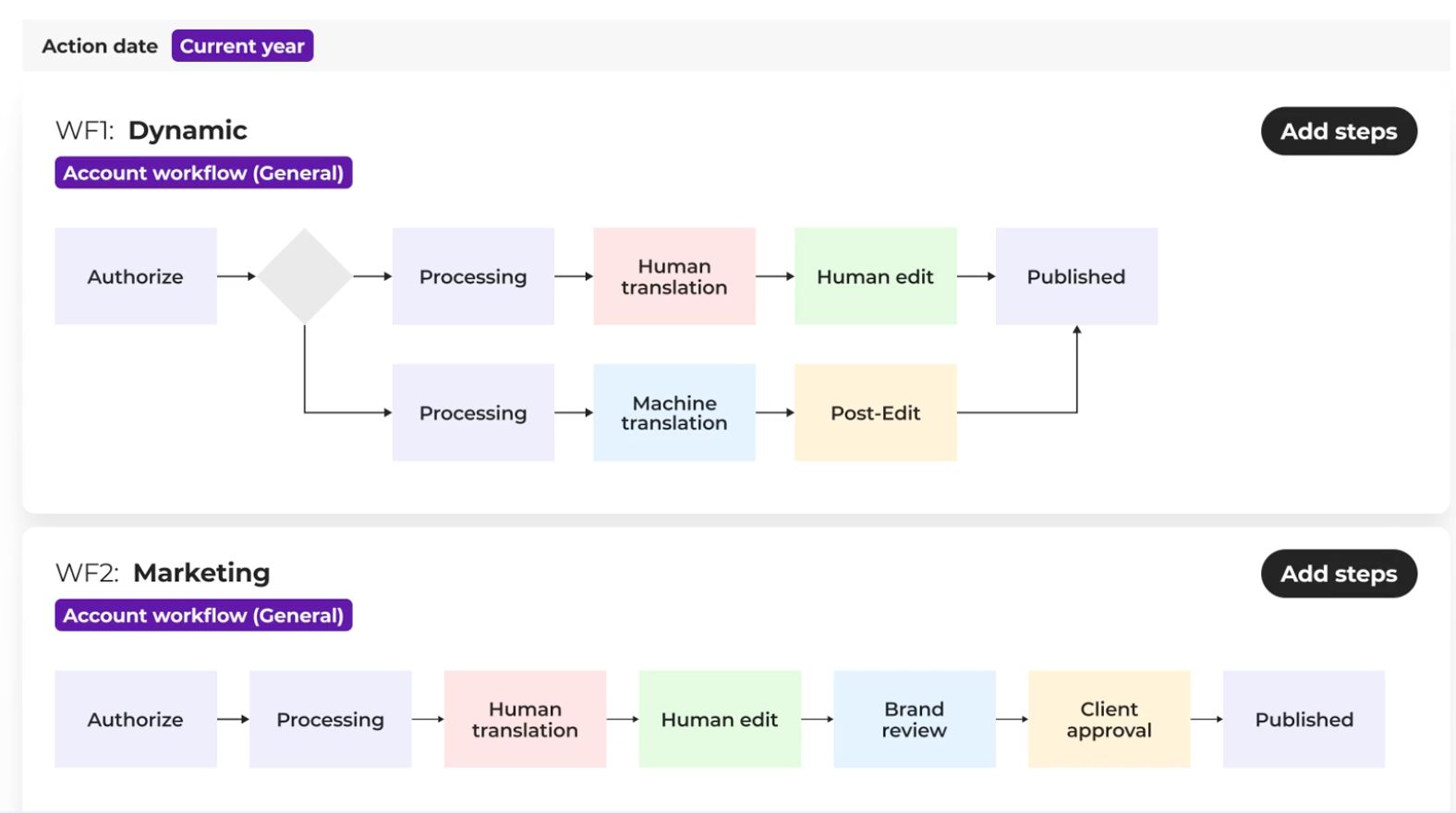
Inside our application, we’ve also been turning many traditional software or manual functions into AI-driven processes. A good example is language quality assurance. It used to be a slow, repetitive task for human linguists, reviewing and correcting translations. Now, AI does most of that work automatically, and a human only steps in when the system is uncertain. That combination has reduced both turnaround time and cost dramatically. Translation is now four times faster than it was just three years ago.
And like many companies, we’re using AI internally to improve efficiency. For instance, we use Fin, an AI customer service tool, to handle support questions. We actually tried building our own system first by connecting GPT directly, but it didn’t work well. Fin, being purpose-built for customer service, was far more effective. It’s trained on our knowledge base and gives accurate, context-aware answers. It’s a great example of how AI can streamline operations when applied in the right way.
Who is your ICP, and how do you identify them?
Our ideal customer profile is made up of the six thousand largest companies in the world. These are typically global enterprises that need to communicate across multiple markets and languages with consistent quality and brand voice.
Within those companies, our main users are usually in four departments: marketing, product, technical documentation, and customer support. Marketing teams use Smartling to localize websites, campaigns, and other content. Product teams use it to translate software interfaces and in-app content for international users. Technical documentation and support teams rely on us to deliver help materials in local languages.
We’re also seeing rapid growth in learning and development and legal use cases. For example, one large hospitality chain uses Smartling to translate training materials for employees in fifty countries who speak a hundred different languages.
So when we identify ICPs, we look for large, global organizations with high content volume and a strong need for consistent, localized communication across multiple regions.
How do you get the best out of yourself personally and professionally?
I try to keep things simple. Early in my career, a mentor gave me two pieces of advice that I still live by: hit your numbers and raise your hand. In other words, do your job well, then look for ways to help solve other problems in the business. That mindset has served me really well over the years, and it is the same advice I give others.
I also believe in staying intellectually curious. I spend at least an hour every day reading industry blogs, newsletters, and reports because our space is evolving so fast that you cannot afford to fall behind.
Finally, I focus on staying healthy. I travel a lot and work long hours, so I make sure to take care of myself physically and mentally. For me, success comes down to three rules: have an impact, have fun, and make money. If I am doing those three things, I know I am in the right place.
BRAIN FOOD 🧠
TOOLS WE RECOMMEND 🛠️
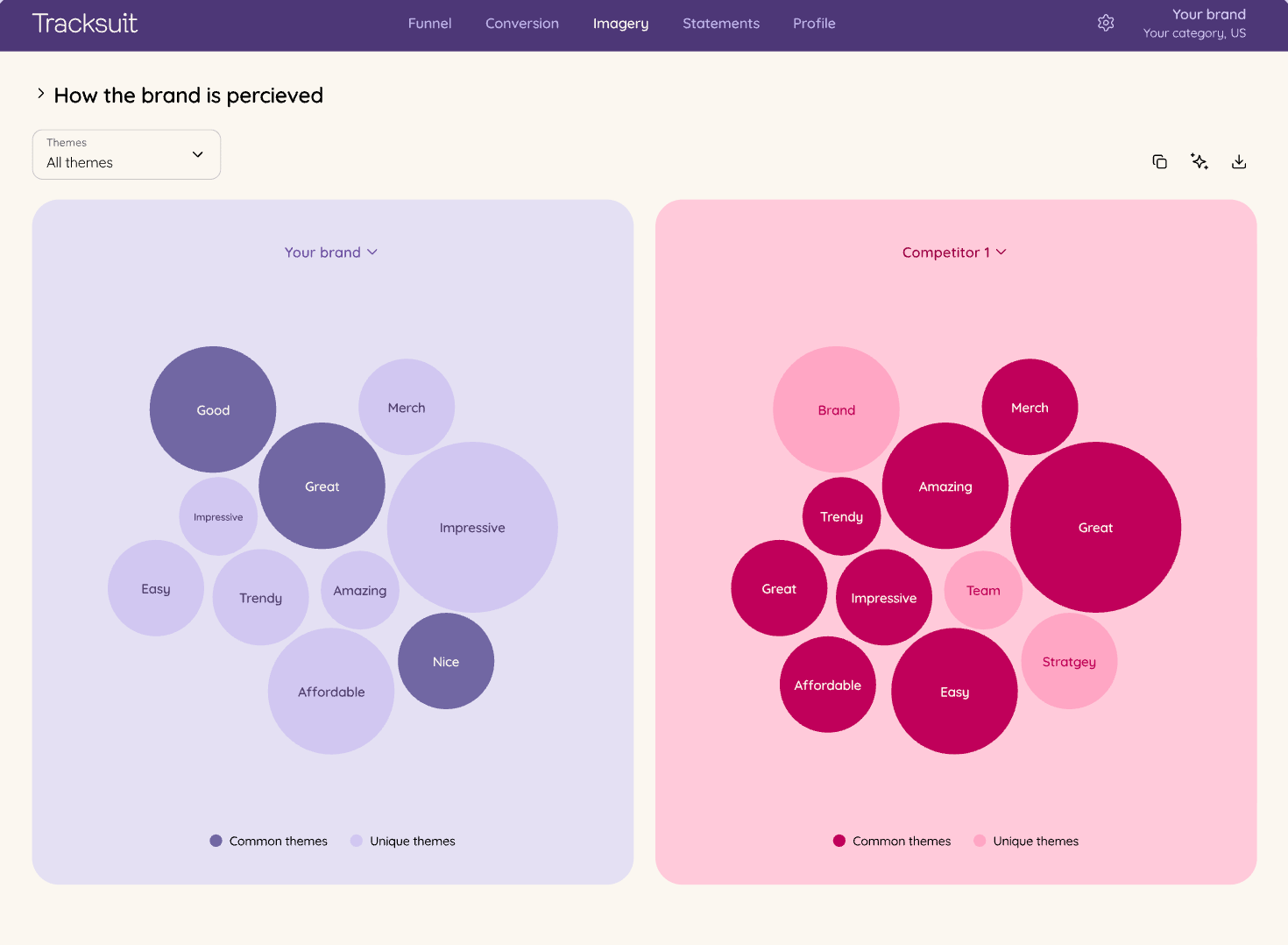
Every week, we highlight tools we like and those we actually use inside our business and give them an honest review. Today, we are highlighting Tracksuit*—a modern brand-tracking platform that shows how your brand is growing, how people feel about it, and where you’re winning (or not) in the market.
 |
See the full set of tools we use inside of Athyna & Open Source CEO here.
HOW I CAN HELP 🥳
P.S. Want to work together?
Hiring global talent: If you’re hiring tech, business or ops talent and want to do it 80% less, check out my startup, Athyna. 🌏
See my tech stack: Find our suite of tools & resources for both this newsletter and Athyna here. 🧰
Reach an audience of tech leaders: Advertise with us if you want to get in front of founders, investors and leaders in tech. 👀
 |
Reply