- Open Source CEO by Bill Kerr
- Posts
- LinkedIn Just Voluntarily Tanked Their Algorithm (+ How To Win)
LinkedIn Just Voluntarily Tanked Their Algorithm (+ How To Win)
We get down and dirty on the tactics to build your brand. 🧱


Bill Kerr & Perrin Carrell
February 19, 2026

👋 Howdy to the 2,438 new legends who joined this week! You are now part of a 261,940 strong tribe outperforming the competition together.
LATEST POSTS 📚
If you’re new, not yet a subscriber, or just plain missed it, here are some of our recent editions.
🥄 Neighbors Feeding Neighbors, At Scale. An interview with Joey Grassia, Co-Founder & CEO at Shef.
💨 Tracksuit’s Bootstrap To Series B. A company that is growing really, really, really fast.
🗣️ Unfiltered: Hyperbound From The Inside. The conversations that shaped the company.

PARTNERS 💫

Delve's AI copilot understands your entire tech stack and tells you exactly what to do next. Just ask it "What's my next step? Take me there," and watch Copilot read your screen and start doing tasks for you. Join Wisprflow, 11x, Bland, and more in the future of compliance with Delve.
Book a demo here to get $1,500 off compliance and see Copilot in action.

Obi by Cor is a voice AI product expert that accelerates customer onboarding and drives adoption. It guides users through real workflows in two-way conversations, tailored to their use cases.
With Obi, you can scale a human-level customer onboarding and activation experience without building large customer success teams. Teams see 2× faster time-to-value and 30–50% deeper feature adoption.
Interested in sponsoring these emails? See our partnership options here.

HOUSEKEEPING 📨
I turned 40 years young recently. And right as I did, I began to notice more and more grey hairs through my beard. What started as a few little white hairs on my chin is spreading like wildfire. First, the random few stranglers on the chin have been joined by countless more, while also beginning to migrate to new lands across the side of my jaw.

But you know what? I kinda like it. I am open to the salt-and-pepper beard look. It’s one of the multitude of ways I am aging—not as ripped, teeth going crooked, wrinkles showing up—that I actually welcome. Aging is a funny thing. I believe it’s like the famous Hemingway line, “How did you go bankrupt? “Two ways: Gradually, then suddenly.”

GUEST POST 💄
LinkedIn Just Voluntarily Tanked Their Algorithm (+ How To Win)
I’m old enough to remember when Sahil Bloom and his gang of Twitter threadboiis were printing cash. A time when culture and narrative all lived on Twitter, and when LinkedIn was primarily known to be where the business nerds hung out. Well, the site that began as an online resume is still the dorky stepbrother, but threaboii’ing is dead, the culture on Twitter X is rotten to its core, and there is only one place where money is made online today: LinkedIn.
While your LinkedIn follower count is never going to get you invited to a courtside NBA date with Kendall Jenner, it can work wonders for everything from bolstering your employer brand to raising money quickly and easily to building an incredible amount of pipeline for you and yours. When the little blue bird gave its last pre-X chirp, the business building baton was officially passed from one platform to another.

How does LinkedIn actually work in 2026, though? Is it threads (no)? Is it rage bait (no)? Is it posting 8,475 times per hour (maybe)? I, for one, have no bloody idea how it works. As a result, I’ve recruited my buddy Perrin Carrell, who runs Playbookz, to educate us. Perrin, the walking, talking algorithm nerd that he is, is the perfect man for this. He has helped execs from Framer, Trainual, Manila, and more build a 10x personal brand. Over to you, Perrin.
The state of things today
Hey team, Perrin here. As you might have seen from the title, LinkedIn blew up its algorithm. If you feel like you woke up one day, and suddenly no one cared what you had to say—unless you decide to become an asshole—it’s probably not you. Everyone’s noticed it. Q3 2025 analysis of 300k+ posts shows organic reach is down 65% from peak, median impressions down 18% year over year, and average creators growing 20% slower. It’s now 10x harder to get reach, harder to grow followers, and harder to make money on LinkedIn.

Source: Swipe Insight (older data but directionally correct).
Is it the LiNkEdIn ApOcAlYpSe?? Not exactly. Yes, it’s a hell of a lot harder. But really, what’s happened is that strategies that used to be effective stopped working and have been replaced with new ones. Doesn’t mean it’s not painful. It is. But people are absolutely still figuring out ways to win (and the best emerging strategies are leading to massively outsized wins; more on that below).
2020: The golden era of LinkedIn $$$$ printing
When 2020 hit, LinkedIn turned into a strange little attention vacuum almost overnight. Conferences died, offices emptied; the whole debacle. And for a lot of people, the feed quietly became the closest thing to ‘the industry’ they had left. But the platform wasn’t mature yet. So, two things were happening: everyone just kind of showed up on LinkedIn, and at the time, only about 1% of LinkedIn members posted weekly.
That accounted for about 3 million of 700 million people, and they shared an estimated 9 billion weekly impressions. It really was a vacuum. LinkedIn responded by whacking open the distribution spigot allllllllll the way. It was stupid. And it was amazing. Literally any doofus who could rattle off a quote about ‘leadership’ or ‘culture’ could build a following. And if you had an image to go along with your text???! |  |
From 2020 to 2023, a small handful of good creators saw the opportunity and stepped into the vacuum. Some became wildly successful solopreneurs. Justin Welsh, an ex‑SaaS exec, started posting daily on LinkedIn around 2018–2019 (saw the vacuum early) and turned a single profile into a media business. He grew to 250k+ followers by 2022 and 630k+ by 2024, building a $10M+ one‑person company at ~90% margins off products like his LinkedIn Operating System and newsletter.
Others built small companies really fast. Andy Mewborn co‑founded Taplio in 2021 and used daily ‘build in public’ LinkedIn content as his primary GTM. In about a year, that attention took Taplio from $0 to roughly $1M in ARR, leading to an acquisition by Lempire and effectively turning posts into a growth engine. Andrew would go on to launch VC-backed Distribute—which now has 15,000 users across Deel, Gong, ClickUp, and more—largely off the back of his audience.

And a few built 8-figure+ companies. Adam Robinson treated LinkedIn as the loudhailer for Retention.com, posting aggressively about email, churn, and spicy growth tactics from 2019 onward. That founder‑led presence helped bootstrap the company to roughly $20M–22M in ARR with a six‑person team, showing a CEO could use the same attention arbitrage to scale a capital‑efficient business.
Of course, that kind of vacuum never lasts. When you’ve got 1% of the platform hoovering up billions of impressions a week and turning them into seven‑ and eight‑figure businesses, the house eventually notices. And over the last 18 months, LinkedIn has started quietly closing the spigot it opened in 2020.
The day the algorithm grew up
It's tough to tell exactly what happens under the hood of a platform, but virtually everyone who measures the LinkedIn algo is seeing more or less the same thing. A Q3 2025 analysis of 318,842 posts found organic reach down 65% from its peak, median impressions down 18% year over year, and average creators growing 20% slower than the previous quarter (Chris Donnelly / Will McTighe). Another Q3 breakdown of 300k+ posts pegs organic reach at roughly 64% below 2022–2023 levels, even as engagement rates are up about 12% because far fewer posts get shown at all.
Operator reports point in the same direction. Multiple creators say they have lost roughly half their reach in 2025, with typical post views sliding from 10–20k down to 3–5k. Company pages are getting hit hardest: several 2025 breakdowns show the average company post now reaching only about 1.6% of followers, with brand content making up just 1–2% of the feed, down from around 7% a few years ago.
*Note: Below are a bunch of snapshots into the state of LinkedIn as of late 2025.
 Source: Social Insider. |  Source: Social Insider. |
 Source: Social Insider. |  Source: Social Insider. |
At the same time, 2025 LinkedIn benchmark studies show engagement per impression creeping up while total impressions shrink, meaning fewer posts get real distribution, but the ones that do tend to perform strongly. Why? Basically, because LinkedIn got a new brain called 360Brew. And it’s pretty much like moving from a jumble of outdated algos to a single, AI-driven nervous system. LinkedIn used to run on a messy stack of different models: one to rank your feed, others to suggest jobs, others to recommend people you may know, and so on. Each had its own rules, features, and data pipelines. Over 2024–2025, LinkedIn started replacing that whole zoo with one giant brain called 360Brew.

Unsure of the context.
360Brew is a 150-billion-parameter, decoder-only foundation model, the same class of architecture as models like GPT, trained mostly on LinkedIn’s own first-party data: profiles, posts, job listings, applications, messages, and interaction history outside the EU.
Instead of feeding it a bunch of hand-built data fields, LinkedIn gives it text: task instructions like ‘rank feed posts for this member,’ snippets of your profile, your past behavior, and candidate items. The model predicts what you’re most likely to click, read, or act on next. That single model now handles 30+ predictive tasks across feed, search, jobs, people, and recommendations, often matching or beating the legacy systems it replaces. Think of it as LinkedIn strapping a PhD-level AI to the feed and letting it decide who sees what, and why. In other words, LinkedIn reads you now.
360Brew actually parses your headline, About section, posts, comments, and job history to decide what you’re about and who should see you, not just how many likes you got. Profile-content alignment matters more than ever. If your profile screams ‘B2B SaaS CEO’ but your posts are generic hustle quotes, the model gets a fuzzy signal, and you lose distribution. Relevance beats relationships. The feed has shifted from ‘who you know’ to ‘what’s relevant.’ Your content now competes across the whole network for people interested in that topic, not just your direct connections.
Cold starts are less hopeless, too. Because the model learns from text and patterns, it can match good niche content to the right people faster, even if your audience is small, as long as your topic and language are clear. That’s a huge change from the old LinkedIn, where distribution mostly depended on existing network strength and engagement history.

Patiently waiting for virtality to hit.
And finally, shallow hacks stand out as noise. Engagement pods, random virality plays, and off-topic posting create inconsistent signals that this unified model can spot and quietly down-rank. That’s why the old ‘just post more and hope the algorithm likes you’ playbook stopped working. There isn’t one dumb algorithm anymore; there’s a single, very opinionated model reading every move you make. Kinda sucks. But also kinda doesn’t.
The old stuff broke, but here's how to fix it
So, the old strategy of just having a pulse and hitting the publish button no longer works. But that absolutely does not mean nothing is working. I’m living proof. Not-so-humble brag: over the last 12 months, I’ve generated ~3.5M views, 6,000+ leads, and ~$1M in new revenue for a relatively tight book of clients.
I helped one of my clients land a contract with Experian, a 7 billion dollar company. I helped another sign Squarespace, a 1 billion dollar company. I also generated calls with Adobe, Mercedes-Benz, and more. LinkedIn is different. But holy shit, you bet your ass it still works. We do it every day. If you want to make a pivot, here’s what works for us.
1/ Write for customer problems
360Brew is constantly trying to parse what you're about. Everything you do needs to speak to the exact customer you want to work with: your banner, your headline, your featured content, your posts, and your comments on other posts. Specificity about a singular problem = semantic relevance. This is NOT fluffy advice. It’s literally how the machine works now.

2/ Create a ‘stack’ of the subchannels inside LinkedIn
The old way was to get organic reach and win. The new way is to combine organic reach, broad paid reach, narrow ABM-style paid reach, outbound DMs, and other ads. To be clear, this is the single most important thing. Each of those used to be kind of its own channel. Now, you need the stack. They feed each other: content creates a warm audience and engagement testing, which leads to cheaper paid reach, which makes outbound DMs warmer and more effective. We still do have clients seeing success with ‘just’ content. But the ones who are really crushing it are leaning into the full stack of marketing subchannels on the platform.
3/ Give away value
I’m sure you’ve seen lead magnets on LinkedIn. They’re the posts that have something cool, and do the whole ‘Comment CRM GUIDE! and I’ll DM you.’ If you haven’t, here’s an example of one we did for a client.

You’ve seen them a lot because they work like crazy right now. I don’t think they’ll work forever, but they check so many of the boxes of what matters to LinkedIn: they’re built to solve a specific problem for a specific person, they’re value-driven and build tons of context with semantically relevant engagement, and they play super well with the ‘legacy’ parts of the algorithm (e.g., ‘engagement = good.’)
But here’s the important part: you should give it away in all parts of your ‘stack.' Content, outbound, ads, all of it. When our clients are landing really big accounts, this is almost always how they’re doing it.
Bonus angle: Stand out by being different
If you want to build a legitimate personal brand on LinkedIn, you absolutely need to stand out. For all intents and purposes, you can stand out in two ways: (1) add tons of value, or (2) have a personality people really like. A really good example is James Hawkins, the CEO of PostHog. James is blowing up and going viral regularly with a strategy that is almost entirely shitposting. Look at the examples below.
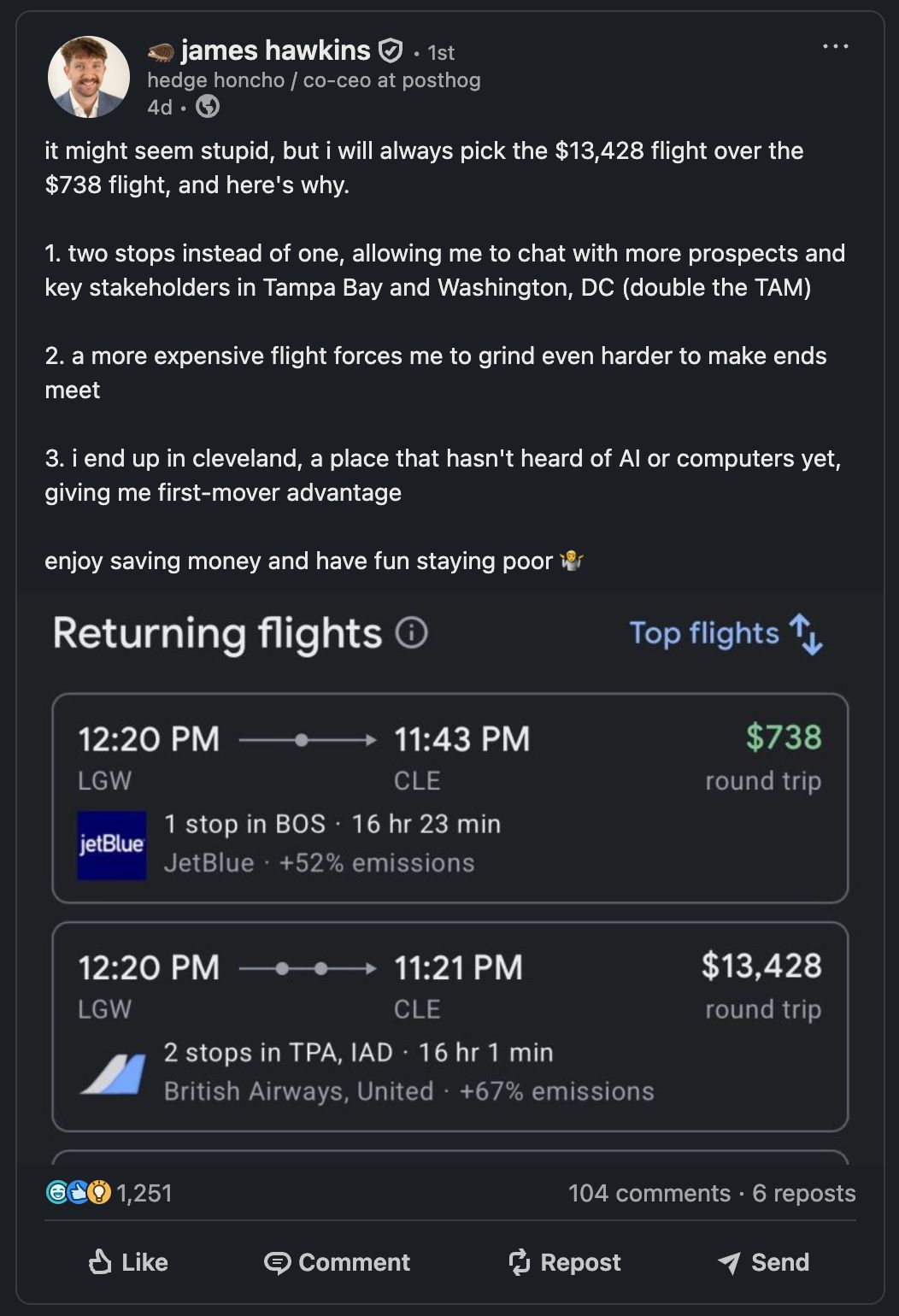

It’s funny. It’s tongue-in-cheek. And it invites people into a conversation that mocks the platform they’re on. And the spoiler alert is that hardly anyone likes being on LinkedIn, so it’s something people are really eager to do. The major caveat is that these posts are not designed to generate business; they're designed to create goodwill. PostHog is highly popular for its brand, design, and tone of voice. James's shitposting works as it fully aligns with the company.

Told you it was weird.
Another important caveat is that, to build this kind of brand, you have to be funny. If you try to do this thing without actually being funny, you usually just end up looking like an asshole.
Playbook / how you can apply this
Hopefully, you’ve seen some opportunities in the strategies listed above that you can apply to your own company. Here are five key takeaways.
Define your one true audience: Create a content strategy that continuously targets a hyper-specific avatar—and then actually try to help them solve problems.
Stack all three subchannels: Combine organic content with thought leader ads, ABM campaigns, and targeted outbound DMs for compounding effects.
Layer on top-performing design: Use carousels and detailed infographics consistently. They outperform text posts and keep people engaged longer on platform.
Productize what you know: Slice off chunks of your expertise and offer them as ‘comment to get this’-style lead magnets.
Consistency is the moat: Post 3-5x weekly for 90-120 days minimum. Most quit early. Persistence creates the actual separation from competitors.
Future
It's going to get harder. Probably a lot harder. 360Brew is barely a year into its rollout, and it's already nuked most people's reach. As the model gets smarter and LinkedIn keeps tightening the screws to push more people toward paid products, the gap between people running a real strategy and people just ‘posting’ will widen into a canyon. The days of winging it and seeing what sticks are cooked.
But that's kind of the whole point. Most people on LinkedIn are still running 2021 playbooks. Generic thought leadership, sporadic posting, zero paid amplification, zero outbound. The bar for good is way higher than it used to be. But the bar for average hasn't moved at all, which means if you're willing to get specific, stack your channels, and actually commit? You're going to stand out more, not less.

My bet is that LinkedIn starts to look a lot like Google did in the mid-2010s. The organic-only window is closing. The pay-to-play layer is getting thicker every quarter. But the people who figured out how to blend both early; they owned their categories for years. We're in that exact window right now. Build the stack today, or write a LinkedIn post in two years about how LinkedIn doesn't work anymore. Your call.
Extra reading / learning
My $1M content marketing framework - August, 2023
How to build an army who will happily promote your content for you - April, 2024
And that’s it! You can follow Perrin on LinkedIn or check out Playbookz on their website to keep up with what they’re building!
BRAIN FOOD 🧠


TOOLS WE RECOMMEND 🛠️
Every week, we highlight tools we like and those we actually use inside our business and give them an honest review. Today, we are highlighting Hyperbound*—the AI sales coach to help you quickly evolve and reinforce your playbooks as you scale.
 |
See the full set of tools we use inside of Athyna & Open Source CEO here.
HOW I CAN HELP 🥳
P.S. Want to work together?
Hiring global talent: If you’re hiring tech, business or ops talent and want to do it 80% less, check out my startup, Athyna. 🌏
See my tech stack: Find our suite of tools & resources for both this newsletter and Athyna here. 🧰
Reach an audience of tech leaders: Advertise with us if you want to get in front of founders, investors and leaders in tech. 👀
 |
Reply