- Open Source CEO by Bill Kerr
- Posts
- Starkian Leadership: The King Who Knelt
Starkian Leadership: The King Who Knelt
The last King in the North, and the greatest leadership story ever told. 🐺

Bill Kerr
December 18, 2025
👋 Howdy to the 1,894 new legends who joined this week! You are now part of a 221,754 strong tribe outperforming the competition together.
LATEST POSTS 📚
If you’re new, not yet a subscriber, or just plain missed it, here are some of our recent editions.
📚 How To Read Like The Greats. Reading is a superpower fewer and fewer are harnessing.
🍟 The Future Of Technology Belongs To One Man, Jensen Huang. Co-Founder, President & CEO of Nvidia, the man holding all the chips.
💘 How Self-Awareness Became The Ultimate Edge. An interview with Jerry Colonna, Co-Founder & CEO at Reboot.

PARTNERS 💫
Framer is giving early-stage startups a full year of the Pro Plan—completely free.

Framer is the design-first web builder that helps startups launch fast. Join hundreds of YC founders already building on Framer. What you get with this deal:
Fast, professional site—no dev team needed. ✔️
Scales with your startup—from MVP to full site. ✔️
Spots are limited—apply before October 31st to claim your free year. *Pre-seed and seed-stage startups. New Framer users only.
Interested in sponsoring these emails? See our partnership options here.

HOUSEKEEPING 📨
One thing that is consistently on my mind is how proud I am of Australia for taking the global lead and banning social media for kids under 16. The law is not perfect, and can likely be skirted, but it’s a line in the sand moment that no other country has been strong enough to follow through on. Social media is a cancer, and we all know it.
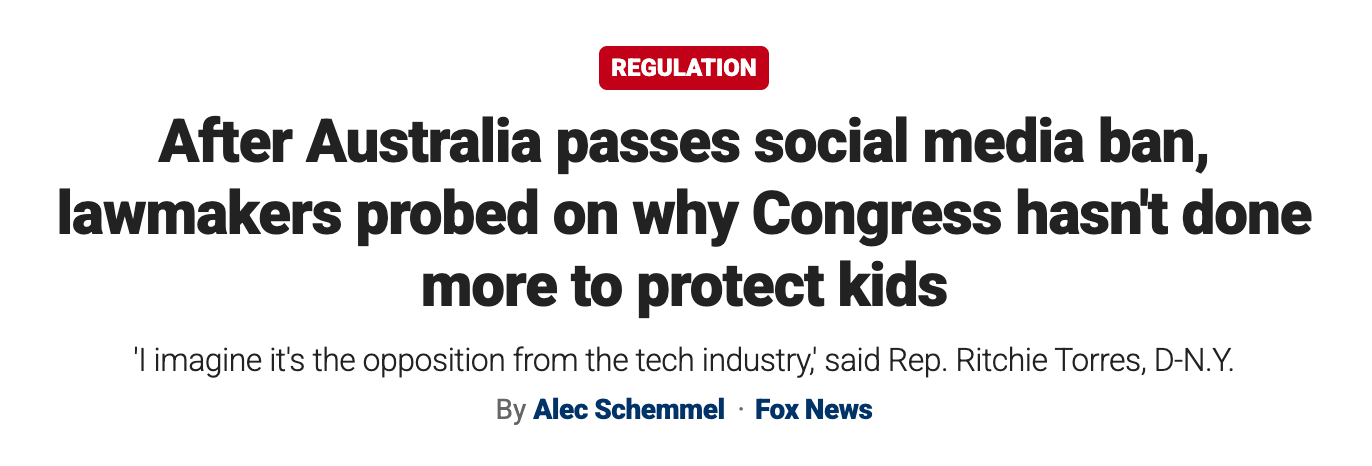
Thanks to this bill, children can now breathe a little easier, knowing they don’t need to be chasing likes and followers the moment they get their hands on a smartphone. This is leadership on the grandest scale, and I am excited to watch this roll out across the globe. Now onto today’s piece, also centred firmly and squarely around the power of leadership. Enjoy!

DEEP DIVE 🕵🏻
Starkian Leadership: The Story Of The King Who Knelt
The greatest leadership lesson I know comes from Game of Thrones. Torrhen Stark, the last King in the North, faced an impossible choice: fight a battle he couldn't win, or kneel before a conqueror and save his people. With 30,000 warriors behind him and 8,000 years of proud family history, every instinct screamed to fight. But fight he did not.
Today, he's remembered as ‘the King Who Knelt,’ a name dripping with shame. But most miss the real story. Torrhen Stark made the most courageous leadership decision in Westerosi history.

Hero or craven?
Fiction? Sure. But Animal Farm, Brave New World, and Dune teach leadership lessons as powerful as any biography. Today's story is about choosing people over pride, long-term survival over short-term glory, and why the Starks remained the most respected house in the North for centuries after Torrhen laid down his crown.
The (brand of the) Kings of Winter
Before diving into the story of King Torrhen, we want to talk about the power of brand. And in this case, the brand of House Stark. You see in the Game of Thrones universe—or for book readers, A Song of Ice and Fire—House Stark reigned as Kings in the North for more than 8,000 years. Game of Thrones is set in a medieval, feudal society, meaning blood, death, violence, betrayal, and war were on their doorstep more often than not.
To put it into perspective, the longest reigning dynasty in real life was Japan’s Yamato Dynasty, spanning a paltry 2,600 years. The Windsor dynasty, now headed by King Charles III, hasn’t yet reigned for 200 years and may all come tumbling down due to one of history’s most troubling interviews with an Epstein-aligned Prince who refuses to sweat.

No sweat here.
How were the Starks able to last so long at the top of their game in the North of Westeros? One word: brand.
What is a brand, and why does it matter
The term brand originates from the Old Norse word brandr, which means ‘to burn.’ It dates back to when craftsmen would burn marks onto their products—think pottery, swords, and livestock.
Today, brand is your money maker. It’s a large part of the reason why people buy from you, whether they know it or not. The best example of a brand is Patagonia, which flexes its brand muscle daily, fighting the good fight for the environment. People like me will pay $100 for an ill-fitting, sweat-inducing T-shirt, because it’s made from reclaimed water bottles.

This book is studied at Harvard Business School.
And their followers do it again, and again, and again. A case in point is their famous Do Not Buy This Jacket campaign. In 2011, Yvon Chouinard told his marketing heads that during the upcoming Black Friday sales, they would allocate their entire marketing budget to an educational campaign about the need to curb consumerism. The result: A record high in sales of the Patagonia jacket.
The result is irrelevant because, at the end of the day, their Patagoni-ites—from cold mountain hiker to Wall Street stock pusher—all believe that they would have done it if it sold no jackets at all.

Here are some mind-boggling stats on brand when related to a company like Patagonia.
Brand helps you attract better talent: Studies show (Cleartrace) that 70% of workers are more likely to apply to a sustainable company. Nearly half of those polled also said they would take a pay cut to work for an environmentally or socially responsible company.
More innovation: Higher levels of purpose drive innovation by up to 30% (Deloitte). Simply put, inspire your employees, and they will work more creatively. Studies also show that (surprise, surprise) more innovative companies outperform the competition.
Higher employee engagement: The average cost of disengaged employees ranges from $3,400 to $10,000 per year. This costs companies $350B per annum (Gallup) in the US alone. Buck the trend. Inspire your people and do better business.
More appeal to your target market: Consumers prefer to buy goods from companies that reflect their values and beliefs when possible (Accenture). 62% of consumers polled said they would choose companies that aligned with their interests.

Source: Accenture.
Create a community: Brands that show a strong purpose in the eyes of consumers are recommended 4.5 times more to friends and family (Zeno Group) than brands without. Build impact and build yourself a pack of raving fans.
Outperform the market: Compelling evidence (EY) shows purposeful companies outperform the stock market by 42%, and companies without a sense of purpose within their mission/vision underperform the market by an average on 40% across the board.
House Stark, like Patagonia, understood the power of brand. That brand, built on unwavering honor and the motto ‘Winter is Coming,’ resonates with its audience much like Patagonia's commitment to environmental causes resonates with its own.
It's about embodying values that create a lasting connection. Just as people buy into Patagonia’s ethos, supporters of House Stark rally to their banner, not for the family's name, but for the ideals and legacy it represents.
Westeros and Aegon's Conquest
In year 1 AC, in the annals of Westerosi history, the stage was set for House Stark to prove their worth. To not only show their strength, but also protect their people. As the conqueror Aegon rolled through the Seven Kingdoms one by one, he made his way to The North, and Winterfell, ready to have King Torrhen swear fealty—or die by dragon fire.
The problem for Aegon, though, is that the North builds hardened folk. Those who, during harsh winters, walk into the snow to die to leave more food for their families. |  Kneeling Man. |
Torrhen’s battlefield dilemma
King Torrhen Stark was a hardened son of the North, from the hardest of Northern families. And as a Northener, he knew that his people—the 30,000 screaming warriors behind him—wanted him to go into battle. But what he also knew was that if he did fight, it was quite likely that he and all of his people would die together out there on the battlefield.
For 8,000 years, his family had reigned as the Kings of Winter. And for every one of those 8,000 years, the idea of bending the knee peacefully and laying down your crown would be seen as the most craven of acts. An act deeming you unfit for the status of your family, and unworthy to sit at the table of your forefathers in the afterlife. He had to choose between his pride and his people.

So on this cold Northern day, as his troops prepared for the attack, King Torrhen made his way out onto the field of battle and knelt at the Conqueror’s feet. He laid down the ancient crown of the Kings of Winter, swearing to be Aegon’s man, rising as Lord of Winterfell and Warden of the North. A king no more.

So, was Torrhen a hero? Or a craven, a coward, a disgrace? History doesn’t paint the full picture in-universe. It’s murky; to some, he is a hero, and to some, he is truly reviled. Even our real-world internet is split on the decision, as the debate rages across Reddit, Quora, and other pockets of the internet.
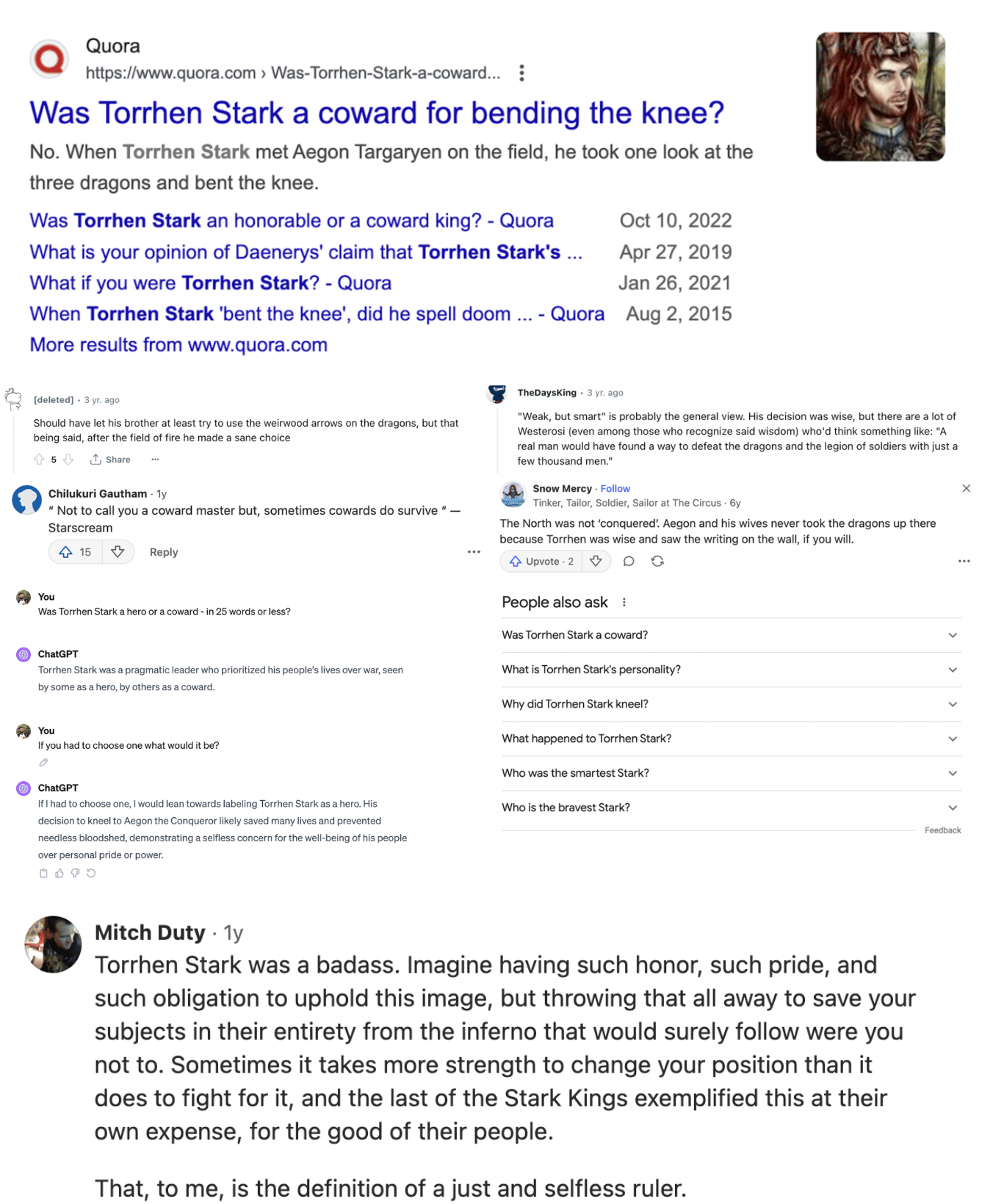
After reading this piece, it’s obvious where I sit. The story of the King Who Knelt is my favourite leadership story: the ultimate act of selflessness and doing what is right under immense societal pressure. This is what it means to be a leader, and this is why the banner of House Stark is as strong as ever before, hundreds of years hence.
How can you apply Starkian leadership
There are many jobs of a leader, but the primary one is to lead. Let’s take a look at some of House Stark’s most famous lines, how you might apply them in your day-to-day, and some recommended reading to accompany.
The man who passes the sentence should swing the sword. —Eddard ‘Ned’ Stark |  |
Make tough calls: Being a leader is about showing an example. Don’t ask the troops to do the dirty work for you. Be in the trenches. If there is a call to be made, whether it's pivoting a product direction or making tough personnel choices, make it yourself. Your team will respect you for it.
I have won every battle, yet somehow I'm losing the war. —Robb Stark, the Young Wolf |  |
Think strategically, not just tactically: There is no use winning every battle, but losing the war. Think in decades. In startups and technology, it's easy to get caught up in immediate victories—successful launches or hitting quarterly targets—but never lose sight of the long-term vision and the business's sustainability.
I am a slow learner, it's true … But I learn. —Sansa Stark |  |
Be a learning machine: Starting out in business, it’s unlikely you can outthink the competition. But if you stay curious, read often, and give yourself time to learn, you set yourself up for massive success.
Bran thought about it. 'Can a man still be brave if he's afraid?' 'That is the only time a man can be brave,' his father told him. —Ned Stark and his son Bran |  |
Be bold, be brave: Leadership is not for the faint of heart. Bravery in business is about making decisions and taking risks even though you don’t have all the data, and the outcome is uncertain.
Fear cuts deeper than swords. —Arya Stark |  |
Be forever the optimist: Running an organisation is about planning for the best, but preparing for the worst. Though, as a leader, you must stay positive. How you behave, and the energy you show, will radiate through your team.
When the snows fall and the white winds blow, the lone wolf dies but the pack survives. —The words of House Stark |  |
Build a culture that will outlive you: Whether you are at an organisation for 1 year or 10 years, do your best to build a legacy through culture. The strength of the team and collective effort is what leads to survival and success.
In memoriam
On the eve of this piece, which also coincides with the day our annual Winterfell Awards—yes, Game of Thrones themed—at my startup are released, I decided to put my money where my mouth is, and tattoo a reminder of House Stark on my right tricep.

“When the snows fall, and the white winds blow, the lone wolf dies, but the pack survives.” A leadership story right out of your favourite HBO series. Although it’s a fictional story, I hope it inspired you in some small way. Maybe it prompted you to reflect on who you look to for leadership inspiration? I know for me it did.
Extra reading
Let My People Go Surfing - Yvon Chouinard, 2005
Don’t buy this jacket, Black Friday & the New York Times - Nov, 2011
And that's it! You can follow me on Twitter and LinkedIn, and also don’t forget to check out Athyna while you’re at it.
BRAIN FOOD 🧠


TOOLS WE RECOMMEND 🛠️
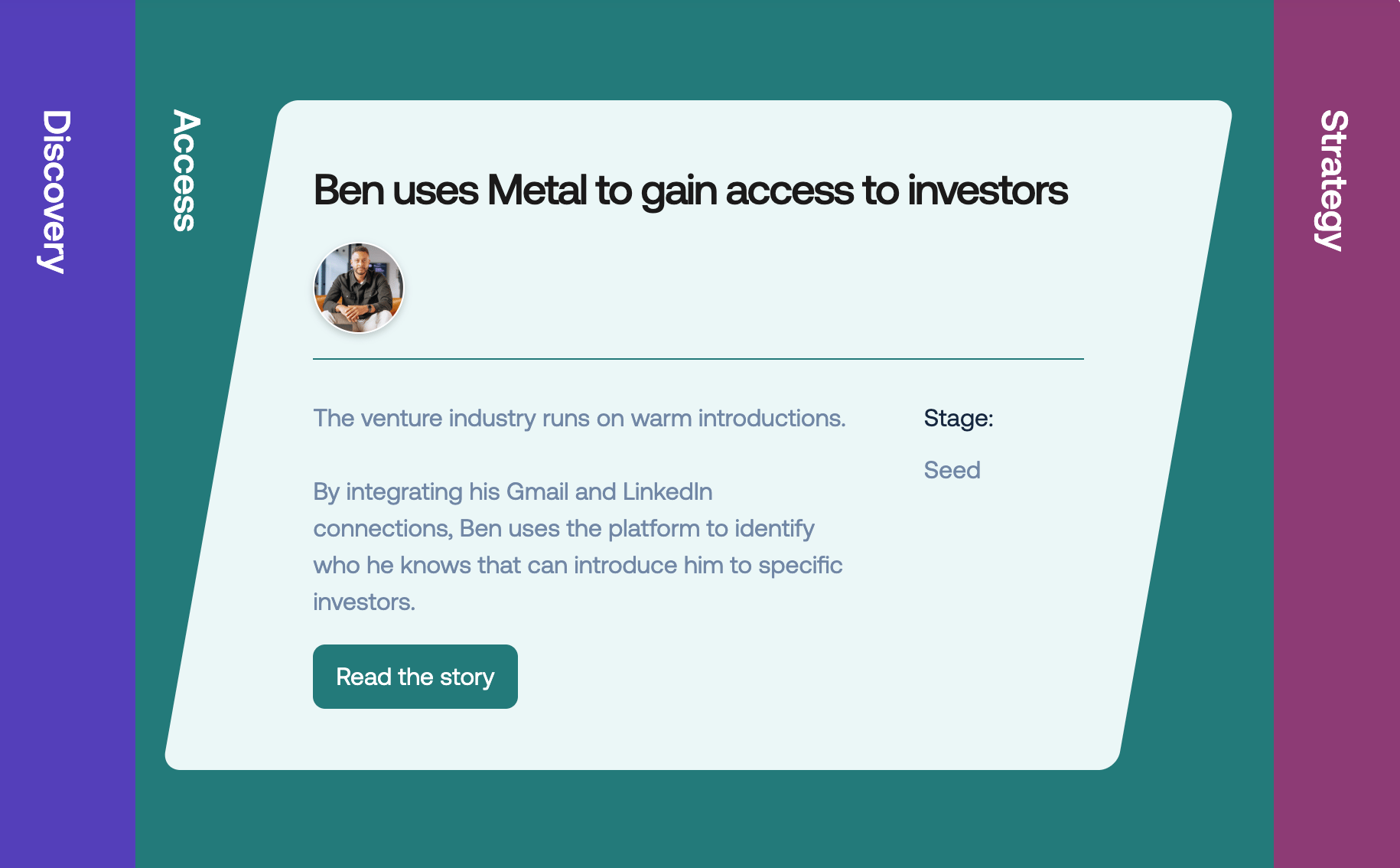
Every week, we highlight tools we like and those we actually use inside our business and give them an honest review. Today, we are highlighting Metal*—a smarter way to search for investors, match by fit, and skip the endless cold-outreach guesswork.
 |
See the full set of tools we use inside of Athyna & Open Source CEO here.
HOW I CAN HELP 🥳
P.S. Want to work together?
Hiring global talent: If you’re hiring tech, business or ops talent and want to do it 80% less, check out my startup, Athyna. 🌏
See my tech stack: Find our suite of tools & resources for both this newsletter and Athyna here. 🧰
Reach an audience of tech leaders: Advertise with us if you want to get in front of founders, investors and leaders in tech. 👀
 |
Reply