- Open Source CEO by Bill Kerr
- Posts
- The Speaking Skills Every Leader Needs
The Speaking Skills Every Leader Needs
An interview with Tristan de Montebello & Michael Gendler, Founders of Ultraspeaking. 🎤

Bill Kerr
March 26, 2026
👋 Howdy to the 4,512 new legends who joined since our last edition! You are now part of a 310,727 strong tribe outperforming the competition together.
LATEST POSTS 📚
If you’re new, not yet a subscriber, or just plain missed it, here are some of our recent editions.
👏🏻 The Invisible Layer Separating Good AI From Great AI. An interview with Tyler Phillips, AI Product Lead at Apollo.io.
🚴 Fundraising Fatigue, Hypergrowth & Selling Glovo. An interview with Oscar Pierre, Co-Founder & CEO at Glovo.
❤️ How Athyna Makes Remote, Work. Tech, meetings, culture & comms. How to do it and maintain 90% engagement.

PARTNERS 💫

First impressions matter. Launch a production-ready site in hours with Framer, no dev team required.
Early-stage startups get one year of Framer Pro free. No code, no delays. Scale from MVP with CMS, analytics, and AI localization. Trusted by hundreds of YC-backed founders.

This is the kind of talent you get with Athyna Intelligence: Research Engineer with deep expertise in PyTorch, deep learning, and LLM workflows. Built to ship models that hold up under real-world conditions.
Applied ML at scale
Fast iteration on real-world constraints
Production-first mindset
40–60% cost savings
Part of our vetted LATAM PhD and Masters network, working in U.S.-aligned time zones.
Interested in sponsoring these emails? See our partnership options here.

HOUSEKEEPING 📨
This week, we welcomed one of the most talented people I’ve ever worked with back into the fold. Sort of anyway. My buddy Lucas Saud, who led sales at Athyna for years alongside Tino, our GM, has now returned as the founding sales manager at Open Source CEO. It’s a real prodigal-son returning from the hero’s journey moment.

It’s amazing that our best keep coming back to Athyna, and in this case, Open Source CEO, but Lucas’s hire is an incredible one for me, because it frees me up to work more creatively and strategically. As someone who has worked 60-70 hours for a decade, I am at a point where I am no longer the engine room. This means I can spend more time taking Ziggy down the beach, as seen in the image above. Oh, and by the way, today’s piece is with a company I am personally using, and loving, Ultrapseaking. Check them out if you are looking to up your leadership game.

INTERVIEW 🎙️
Tristan de Montebello & Michael Gendler, Co-Founders of Ultraspeaking
Tristan de Montebello and Michael Gendler are the co-founders of Ultraspeaking, a communication school built on a counterintuitive idea: most speaking advice fails because it focuses on surface-level fixes instead of the real problem: what happens inside your head when the stakes go up. Tristan's story is the company's origin story. In 2017, he went from avoiding public speaking entirely to competing at the World Championship of Public Speaking, becoming the fastest competitor in history to reach the finals in just seven months. His coach through that journey was Michael, a UCLA computer science graduate who had made an unlikely leap from software engineer at companies like Symantec and Hulu to one of the world's leading public speaking coaches.

Together, they have coached Fortune 500 executives, entrepreneurs, and creators with 1M+ subscribers to speak with confidence in the moments that matter most to them. Their method is like nothing I've seen. Instead of memorizing frameworks or counting your 'ums,' they focus on rewiring how you think and perform under pressure, using fun, high-energy games that simulate high-stakes moments in a safe environment where you practice and get real-time feedback from peers and coaches. The results have earned them a very loyal following of founders and leaders, including me, Lenny Rachitsky, Eric Partaker, Chris Donnelly, Tiago Forte, Jesse Itzler, and Greg Isenberg.
Why are you guys building Ultraspeaking?
Tristan: For me, it's my longest and most personal project. Ultraspeaking was born of my own journey to figure out the root cause of what was holding me back from communicating effectively. It was the anxiety and overthinking. Once we solved that, while still allowing me to feel like myself, my quality of life improved so dramatically that I discovered a deep passion for this path. I hope that the entire world experiences what I've experienced. It's as simple as that.
Michael: Speaking is a meta skill, and unlike piano or some really narrow skill, a meta skill feeds into so many other aspects of your life and elevates them. Public speaking is not really the skill we are passionate about; we're passionate about the skill of feeling at ease in every scenario. The ability to express yourself effectively everywhere: in the presentation, in the meeting, in the difficult conversation, on stage, off stage, introvert, extrovert, it doesn't matter.
That's the meta skill that makes life so much richer, because most people are carrying around a lot of self-consciousness, a lot of anxiety, a lot of imposter syndrome. That's a drag on your life, a weight that is just making life more miserable than it has to be. | 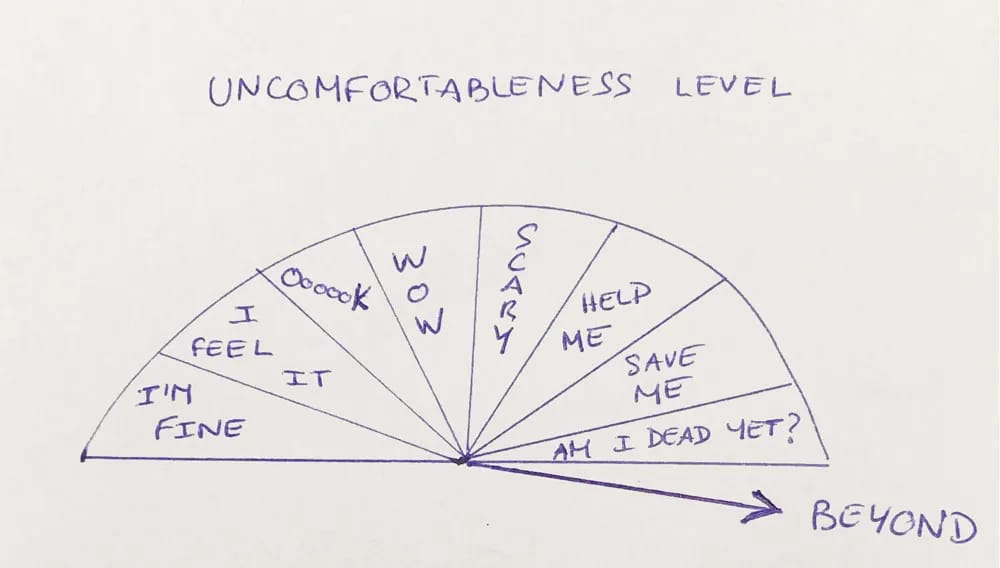 |
Lifting that weight off and letting it go means you walk around feeling lighter everywhere you go.
The compounding effect of that is not only that you feel better, but that you perform better, too. Speaking is a huge part of our professional success and our relationships. Improving your speaking skills compounds exponentially on how the rest of your life goes. So if there's any skill to invest in, speaking is a good one, because we spend most of our lives doing it.
Are there mental health benefits to actually working on this as a skill?
Tristan: When you don't trust your ability to get what's in your head out into the world, and instead you're carrying this belief that you're going to say the wrong thing, that takes a real toll on your nervous system and your psyche. The way I like to think about it is that most people are navigating the world like an obstacle course. There are areas where you feel comfortable, and you're fine there. But then there are all these other situations where your nervous system gets jacked up, and you lose confidence and sleep over them.
For example, more commonly than you’d think, I’ll coach someone who thinks getting up onstage in front of 1000 is not a big deal, but they are terrified of a board member asking them a question they don't know the answer. So they over-prepare for those situations and overthink them, or they find a way to avoid them entirely. That takes a toll on their mental health.
One day, in the early years of my being an entrepreneur, there was an influencer who was really interested in our product. He invited me to an event. I didn't really know him beyond a few interactions, but he was a big deal in my mind. I remember showing up, and he was standing right in the entryway. It was on a boat on the Seine in Paris. There was no way to walk in without passing him. I knew he knew what I looked like, and I immediately recognized him.
I got so scared because I didn't know what to say or how to talk to him. And this all happens in seconds. I'm walking towards him, I pull out my phone pretending I'm getting an important call and start talking: 'No, really? Is that really happening? Oh my goodness.' I stood near him for about ten minutes on this fake call, debating what to do. And then I left the event without going in. I think a lot of people live in a world where some version of that is true.
What are some common misconceptions about public speaking?
Michael: A really common one is around clarity. What's clear to you may not be what's clear to others. I see frustration around that all the time. People think, "I explained that so well.” Or “We talked about this.” Or “Why is this other person suddenly coming back to me, not doing what I asked them to do?" Well, you thought it was clear to you, but was it clear to the other person?

It’s surprising. When we study communication clarity, we realize that most leaders and executives still struggle with speaking at a high level. They default towards complexity over simplicity. They feel they need to go into detail to be clear. The most common reality is that they are not even clear on what the most important thing they want to share is.
Clarity is about simplicity. It's about recognizing the one thing you want your audience to remember. If you don't have clarity for yourself, your team will never find it in the details.
What are the things that differentiate great leaders from not-so-great ones?
Tristan: Great leaders listen. I think it's underappreciated how much listening is a part of excelling at effective communication. A classic situation is when everyone is going around the room introducing themselves, and you're the last to go. Instead of listening to who everybody is, you're rehearsing what you're going to say because you're afraid that when your turn comes, you won't know what to say. The only way you can truly listen is if you trust yourself enough to know that in the moment, the right words will come.
Michael: A surface-level public speaking coach might say great leaders pause, but that's just the symptom they're observing. The pause comes from a place of unhurriedness. There's no rush. Unhurriedness also allows a leader to speak with conviction, because when they say something important, they let it breathe. They pause and let the words sink in.
Sometimes I see leaders say brilliant things, and the moment they land their point, they're already on to the next words. They're rushing because they fear that if they take up too much space, people will get bored.
 | Unhurriedness really comes from a place of believing that you deserve to take up space. It's worthwhile to pause. The audience will appreciate the time you give them to digest the importance of what you're saying. |
That level of confidence to pause, to take your time, is a hard skill to train out of the box. It lies on the level of your belief systems, your sense of worthiness, and your sense of belonging.
It’s why another common misconception about speaking is that it's just a tactical skill set, when it's not. It's a tactical mindset: a set of beliefs and mental models that unlock your speaking skills.
What are the most common areas for improvement for a leader?
Tristan: The first thing I look at is where this person is on the spectrum of speaking anxiety. Are you the type of person who tends to avoid high-stakes speaking or looks forward to it? That's the foundation of it all. The types of people who wouldn’t walk up to the influencer because they’re scared can learn as many frameworks, tips, and techniques as they can fit into their brains, but nothing will work. They are also the types of leaders who hold back what they're actually thinking in a group.
For the people in the middle of the spectrum, and most high-performing leaders fit here, their challenge still stems from self-doubt, but it just shows up differently. They’re rambling, or they’re speaking really fast, or they’re monotone. They tend to speak a lot.
Michael: We were hired by a CEO to work with his entire leadership team. It was really interesting. Half of the people had the problem of being talkers: rambling, circling around the point, being too verbose, or not getting to the point quickly enough. The other half had the opposite problem, as Tristan brought up. They’re brilliant, but they weren't speaking up. They were hesitating, not sharing what was actually on their mind unless prompted. They needed more confidence.
What I find most interesting is that the CEO was an exceptional communicator and is someone who looks forward to speaking in all professional scenarios. But the moment the camera came on, he’d become robotic and just couldn't feel natural. We’re seeing a big trend of CEOs coming to us for help with this as they build their personal brands to market their company. Learning to be conversational, at ease, and to express yourself well, no matter what scenario you are in, is probably that final meta skill that we found leads people to enjoy speaking. That comes down to having enough reps and the right mindset.
💡 Note: I am currently using Ultrapseaking myself, and I absolutely love it. Big recommend if you are looking to sharpen your leadership!
What methods do you use with broad groups, and how do they work?
Tristan: I think it's important to understand how we think about communication training and how different it is from what most people have in their minds. If you look at the lay of the land of what communication training looks like, it is very much framework-oriented: use this framework, this tip, this structure, and these rules, without looking at where you are. What we've found is that that is not the most effective approach, and perhaps just as importantly, it's not the approach that will activate the lever of the meta skill where it starts impacting everything else in your life. We train by rewiring your brain and relationship to speaking. One of my favorite tools for that is a game we created called ‘Conductor.’
In the game, I control your energy, vocal variety, and intensity as you speak. I give you a random speech title and ask you to change your energy levels—sometimes with big jumps and contrasts, from very low to very high energy, or from low intensity to high intensity —while also exploring different emotions: excitement, frustration, introspection, and everything in between. The reason this exercise is so effective is that you discover everything you need to let go of control. It's a tool that acts as a mirror, showing all the areas in which you tend to have low trust in yourself, the areas that feel very much unknown to you.
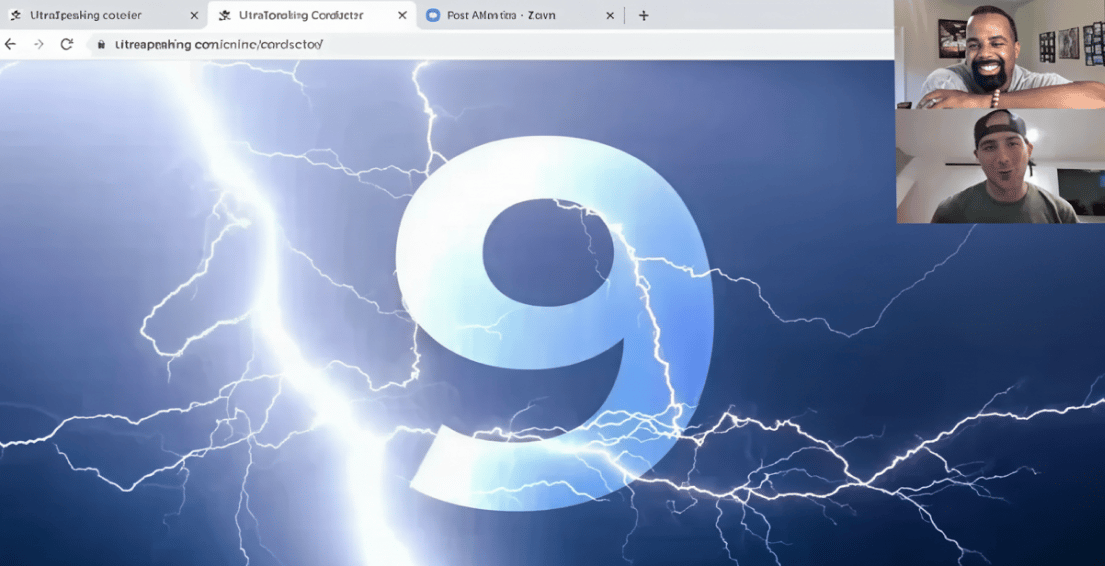
Ultraspeaking coach, training using the game ‘Conductor.’
In the game, the Conductor will say, "Raise your energy to an eight, nine, or ten out of 10 intensity," and you can't do it; there's no way you're going to have conviction in the meeting. If the conductor says, "Give me a one, two, or three out of 10. Really slow it down," and the person keeps speaking quite fast and won't pause, there's no way you're going to have executive presence or gravitas in the meeting.
So, going through the Conductor exercise helps surface the skill sets required for being an effective, well-rounded communicator.
Michael: I want to share an effective method for presentations. It's called the ‘Five Minute Presentation’ game, and we play it in one of our cohorts. You have five minutes to create a presentation on a topic you just heard about, complete with slides, and then you have to present it. That's insane time pressure; having to think, design, and present a slide deck in five minutes is really tough, but it builds the right fundamentals.
First, it forces you to figure out what's the one message that matters most. Many people don't even think about that when they have two days or two weeks to prepare a presentation. Second, it reminds you to set an intention, because one of the biggest levers you have when presenting is deciding how you want to make people feel. ‘Am I going to use humor? Is my point here to entertain, to inform, to inspire?’ Most people don't set that consciously, so they're not pre-planning or trying to optimize for an audience reaction.
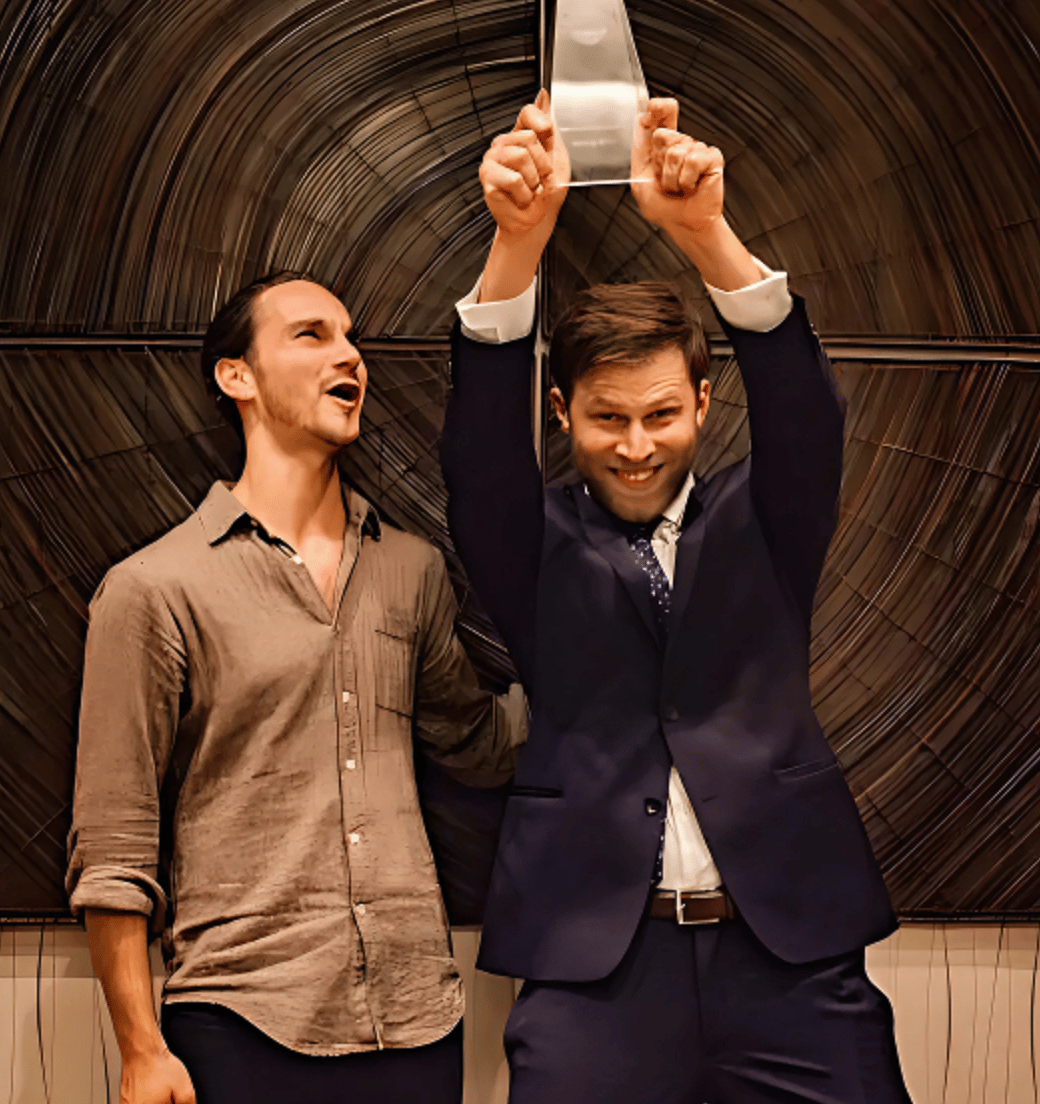 ‘The champ is here.’ |
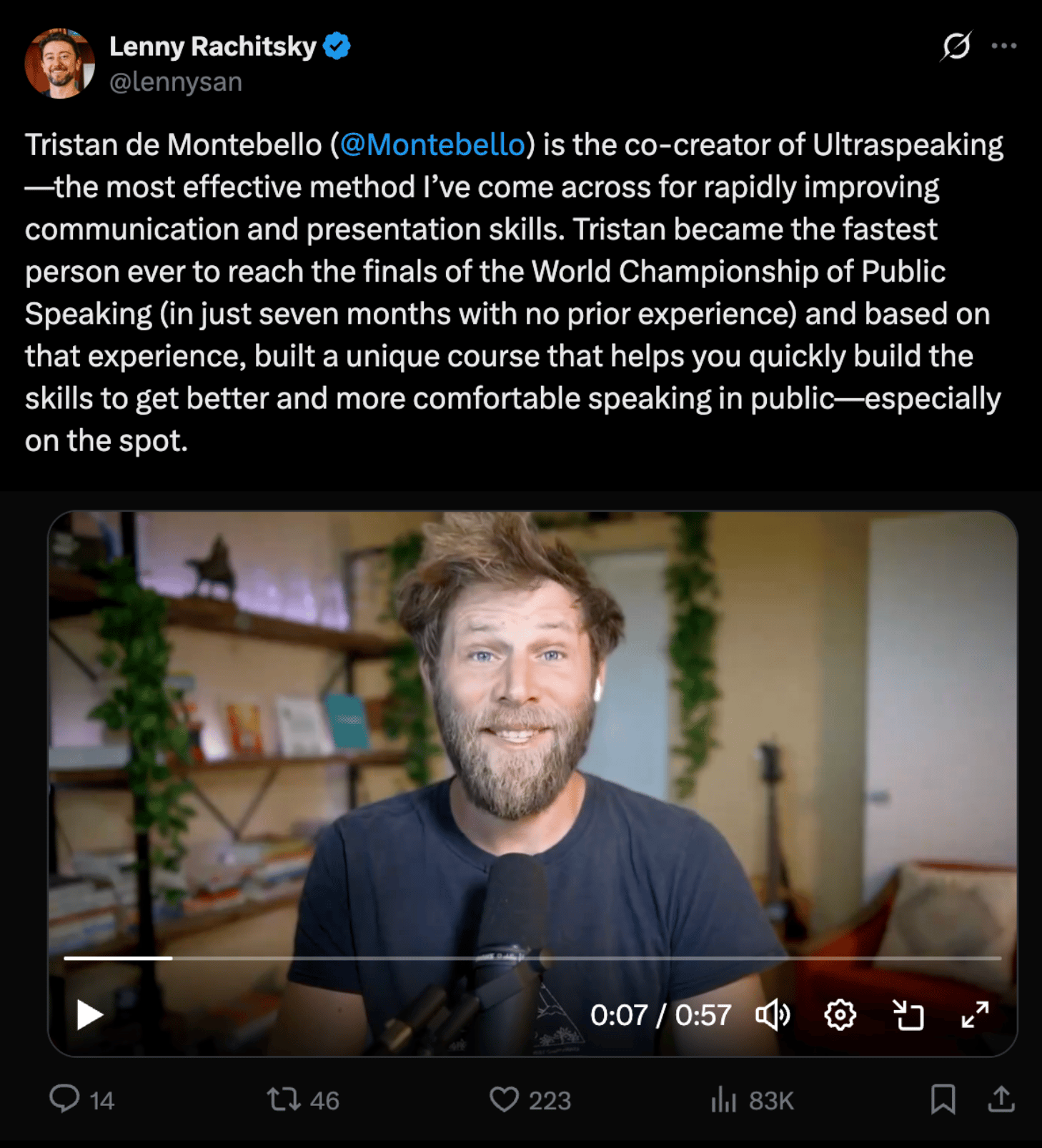
Third, it builds the best habit of not overcomplicating your slides. When you're playing the ‘Five Minute Presentation’ game, you can really only do one image and one headline per slide, and as a result, you build what we call the ‘campfire effect’: the effect where your slides are there to create ambiance and support your story, not to dominate and take away from the spotlight.
This game is a really fun way to get lots of reps in within a single hour. It helps people overcome perfectionism when it comes to presentations and build the highest-leverage habits so they can ingrain the skills that matter most when presenting.
What does real executive presence look like on a stage?
Michael: Most people think that executive presence looks like a sort of posturing or confidence, so they try to emulate the physicality of it. Maybe you stand with both feet solid, maybe you have your shoulders back, maybe you punctuate your words with hand gestures, maybe you speak with conviction. But I don't think that's what executive presence really means, because when I study executives—whether on a stage or in a meeting—presence, to me, means complete ease. Complete ease and certainty in oneself.
That could look like a commanding presence if that's what ease feels like to you. But to a lot of people, ease feels like being able to sit back a little in a meeting, maybe even slouch a little, because you're comfortable. You have no self-consciousness about what other people are thinking of you.
Think about the CEO; they're probably oftentimes the most relaxed person in the room, because everybody reports to them. Everybody else is on edge, but the CEO is relaxed. So how does the CEO behave? In a relaxed way. They'll crack jokes, they'll use humor, they'll lean back. To me, that is a more modern-day version of executive presence. If you try to fake executive presence, you might sit straight or stand up with great posture, but you'll be performative. You'll be trying to act like an executive, but that's not the goal. The goal is to feel like an executive. And what do executives really feel once they have the title and the experience? They feel at ease. They're relaxed.
I think that's what you want to see on stage: someone who is conversational, someone who has humor, somebody who's not afraid to laugh at themselves, and somebody who, when the time is right, will drive their point home with conviction, in a way that's unhurried, because ultimately they believe that they deserve to be there and that what they have to say really matters.
What's an example of someone making a transformation working with you?
Tristan: I have a person who comes to mind, a very senior executive of an engineering team at a big tech company. He is a remarkable expert in his field, truly top 0.1%. Yet he was carrying a debilitating anxiety around speaking that no one was aware of. Not his family members, not his girlfriend, nobody on his team. Nobody. He had gotten really good at avoiding speaking in groups. He would give a presentation to a member of his team to present or use 1:1s to communicate.
What's interesting about this person's story is that, when he joined Ultraspeaking, he felt, after just a class or two, that it was too hard to overcome and that his situation was too unique to fix. He quit. And three months later, he came back, and this time he said, "I don't care what it takes, I'm doing it. Enough is enough." He became one of our star students. He took all of our courses multiple times and trained every single day. A few things happened. | 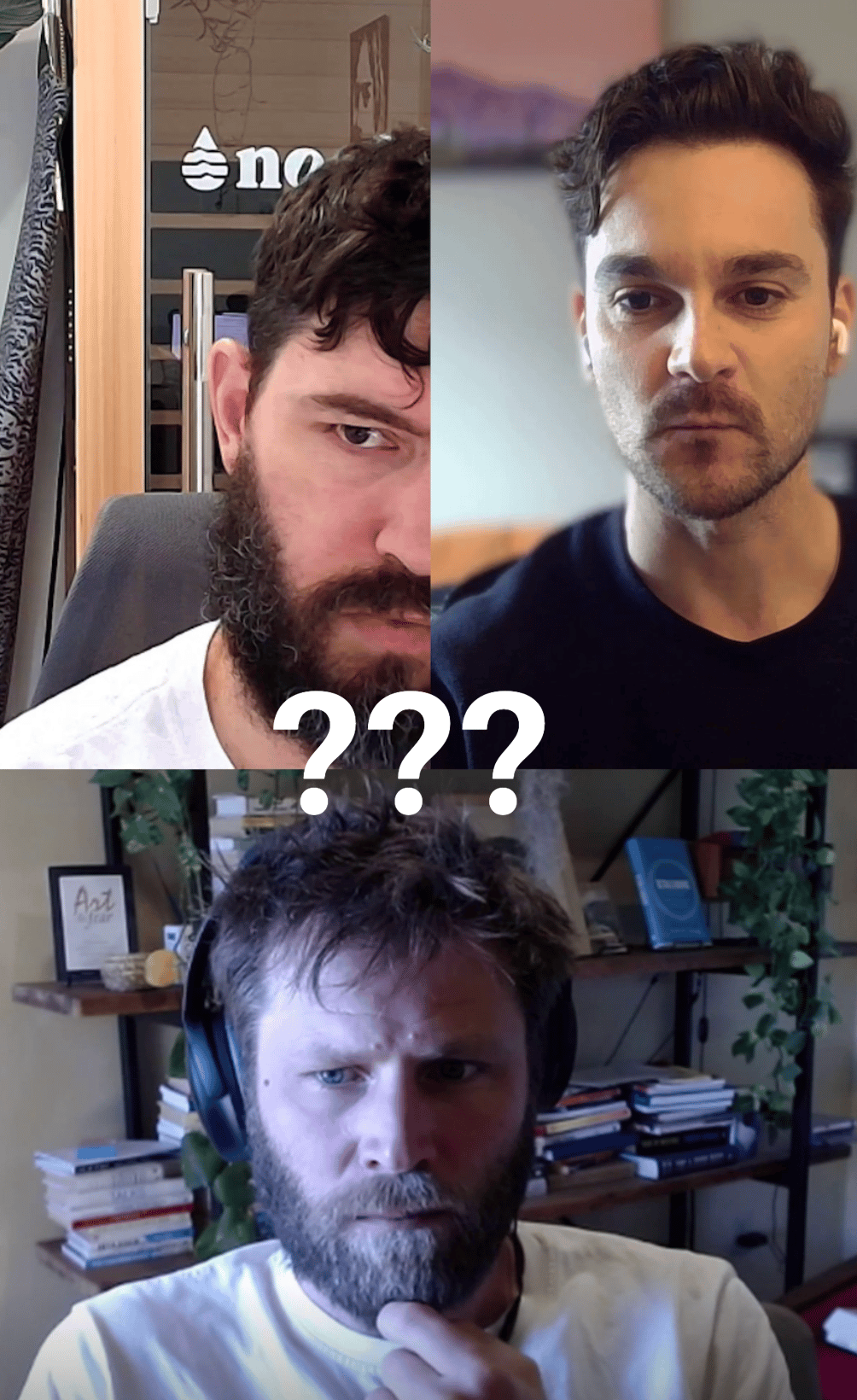 |
One, he discovered he was definitely not alone. There are, in fact, an insane number of people who experienced the exact same thing, and he had found a community where all kinds of very powerful, interesting, smart people were working on the exact same problem.
That transformed how he felt about himself, especially at work. What makes this story stand out for me the most is that I had a conversation with him after he visited his family for a few weeks. He told me, "I had deeper conversations with my siblings than I have ever had in my entire life, and I attribute 100% of this to the transformation I went through in Ultraspeaking."
Michael: The person that keeps coming to mind is Tristan. He's my favorite success story. Here's a guy who was just an average person with no speaking training, who would actually turn bright red every time he spoke in groups. It was a friend of his who said, "I think if you're going to spend time developing a skill, do a meta skill." That's actually how we even learned about the phrase meta skill.
So Tristan decided to study public speaking since it was a meta skill where he was truly starting at zero. And because he's a unique learner, who dedicated hundreds of hours and intensity, his first accomplishment was reaching the finals of the World Championships of Public Speaking in just seven months, which is insane. That doesn't just happen.

A happy bunch of confident speakers.
The reason I love this example is that, first, it shows that all of this is entirely learnable. Everything in the world of speaking, leadership, and communications is learnable, but you have to find the right way to learn. It has to be motivating and fun so that you stick with it, and you need good mentors, coaches, advisors, and a community surrounding you on the journey.
Second, it compounds exponentially and changes your life. He never expected to win the semi-finals. He never expected to start teaching and coaching speaking skills. He never expected to be the CEO of a communication company. For myself, when I started working on my speaking skills, I just did it to overcome anxiety. I didn't expect that a year in I would be able to negotiate 2x my salary. There are so many implications: a better career, a better salary, new opportunities, starting your own business, and recording videos on YouTube.
Your whole life can change when you start working on your speaking skills, and you can't really predict how. But the momentum you build and the skills you unlock will open up a whole new world. Tristan is an example of the extreme of what's possible, but I've seen a lot of extremes, and that's the beauty of this skill. It really changes your life.
Extra reading / learning
Why most public speaking advice is wrong - October, 2024
How to speak clearly on-the-fly - March, 2024
5 Powerful Habits To Build Unshakeable Confidence - February, 2024
And that’s it! You can follow Tristan and Michael on LinkedIn to keep up with them. Or check out Ultraspeaking at their website to learn more.
BRAIN FOOD 🧠
TOOLS WE RECOMMEND 🛠️
Every week, we highlight tools we like and those we actually use inside our business and give them an honest review. Today, we are highlighting BILL—only one platform for managing bills, spending, payments, and approvals, with automated workflows that cut down manual work.
 |
See the full set of tools we use inside of Athyna & Open Source CEO here.
HOW I CAN HELP 🥳
P.S. Want to work together?
Hiring global talent: If you’re hiring tech, business or ops talent and want to do it 80% less, check out my startup, Athyna. 🌏
See my tech stack: Find our suite of tools & resources for both this newsletter and Athyna here. 🧰
Reach an audience of tech leaders: Advertise with us if you want to get in front of founders, investors and leaders in tech. 👀
 |
Reply