- Open Source CEO by Bill Kerr
- Posts
- Self-Awareness As The Ultimate Edge
Self-Awareness As The Ultimate Edge
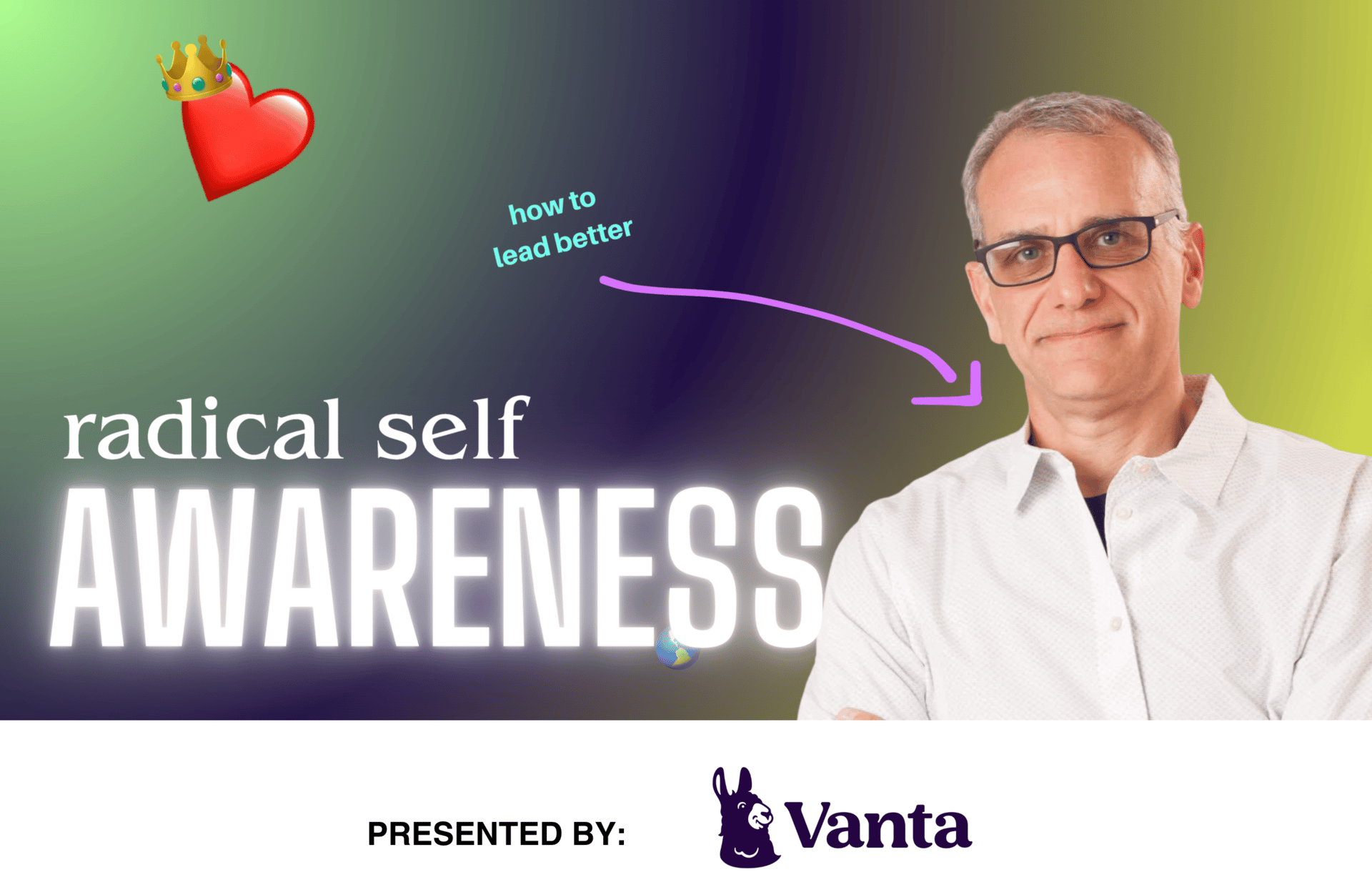
An interview with Jerry Colonna, Co-Founder & CEO at Reboot. 💘

Bill Kerr
December 07, 2025
👋 Howdy to the 1,862 new legends who joined this week! You are now part of a 214,487 strong tribe outperforming the competition together.
LATEST POSTS 📚
If you’re new, not yet a subscriber, or just plain missed it, here are some of our recent editions.
📣 A Guide To Crafting Your Brand Voice. A step-by-step guide on creating a tone & identity your audience will love.
🏎️ If You Ain't AI First, You're Last. A behind the scenes founder’s guide to your AI transition.
🌵 Unlocking Engineering Intelligence. An interview with Anish Dhar, Co-Founder & CEO at Cortex.

PARTNERS 💫
AI has unlocked new velocity for startups—and new visibility, too.
The faster you grow, the sooner you’ll need to prove you’re secure enough to play with enterprise customers.
The tl;dr? You need compliance to sign deals.
Join Vanta for a session on how to make compliance work at your pace, without slowing momentum, stalling deals, or putting revenue at risk.
We’ll cover essential steps you can take now to prepare for your first audit in 2026—and enter the new year ready to earn customer trust (and deals).
You’ll walk away with:
Tips on identifying the right framework(s) for your startup
Advice on how to work security into your budget
Security best practices to implement now so you’re audit-ready next year.
Interested in sponsoring these emails? See our partnership options here.

HOUSEKEEPING 📨
This week seemed to hit the most fever-pitched pushback against the newly founded prediction markets gambling industry in the U.S. And I am all for it. Think of all the human capital and VC dollars going to sectors that are making the world unequivocally worse. Look at Tarek Mansour here, co-founder of Kalshi, actually bragging about trying to embed gambling into ‘everything.’
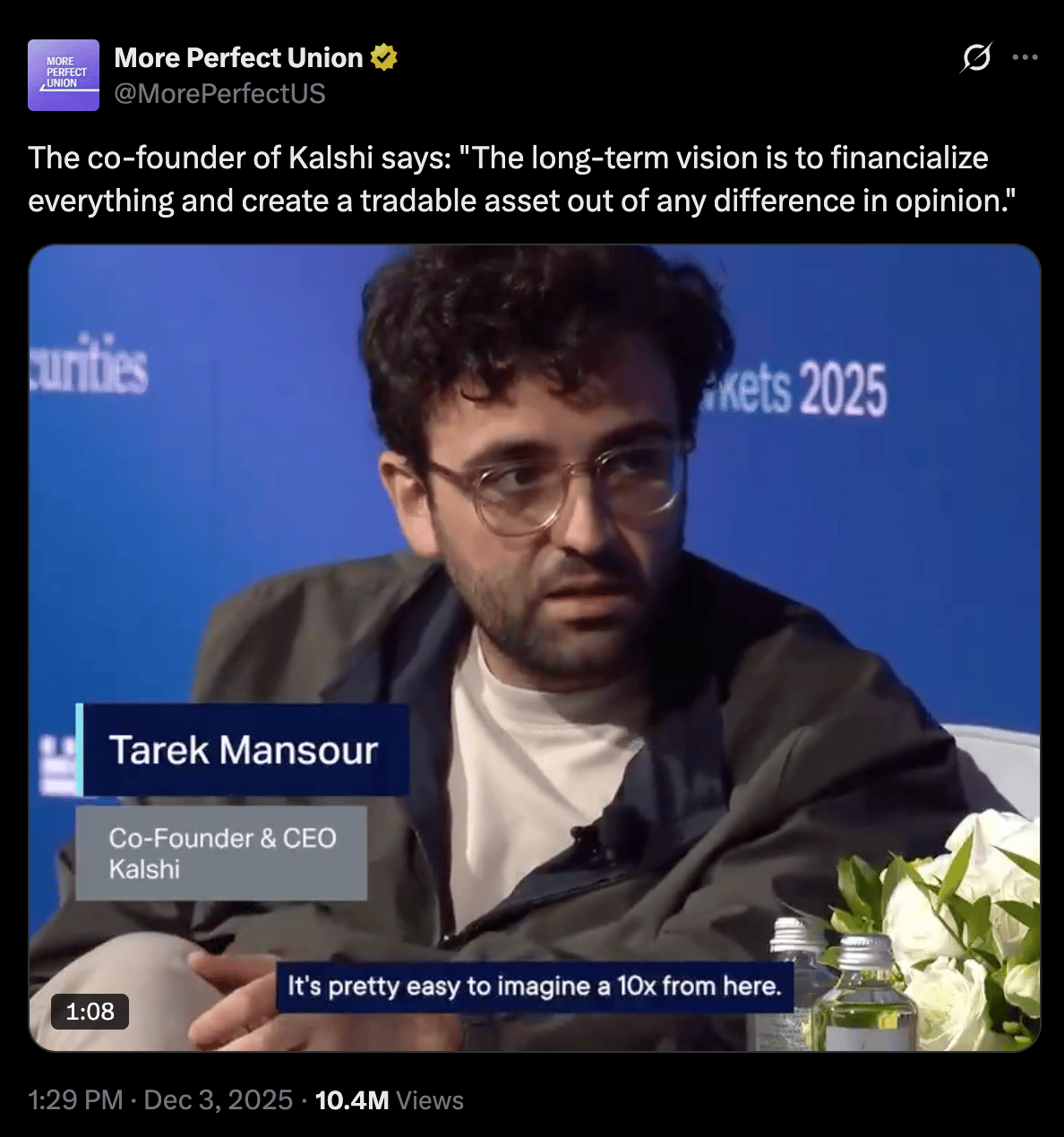
This is the equivalent of the co-founder of Phillip Morris standing on stage proudly and exclaiming, ‘We are going to be tobaccotize everything.’ How on earth can we in the tech industry put up with this garbage? Tech is quickly becoming the global bad guy—social media, phone addiction, brain rot, conspiracy, gambling, and porn. Our job as leaders is simple. Find a product or service in the world that doesn’t exist, or exists in a sub-optimal way, and either go out and create that new value, or improve upon what exists.
What our job is not is to scour the world for ways to exploit human psychology for monetary gain. People like Tarek should be ashamed of themselves. And it’s so short-sighted. What he is not considering is how he will explain to his grandchildren how he spent his time during his prime entrepreneurial years. It’s just sad all around. Anyway, enough about that, on to today’s piece! Enjoy!

INTERVIEW 🎙️
How Self-Awareness Became The Ultimate Edge
Jerry Colonna is the Co-Founder and CEO of Reboot, a leadership coaching company known for blending radical honesty with deep self-inquiry. Before becoming one of the most respected executive coaches in the startup world, he built a successful career in venture capital, serving as a partner at J.P. Morgan Partners and co-founding Flatiron Partners, one of the most influential early internet venture funds. His work today focuses on helping founders and leaders confront their fears, find meaning in their work, and lead with empathy and authenticity.
He’s also the author of Reboot: Leadership and the Art of Growing Up and Reunion: Leadership and the Longing to Belong, both of which explore how emotional awareness, vulnerability, and maturity can transform leadership. Combining his experience as an investor, Buddhist practitioner, and coach, Colonna challenges traditional notions of success—encouraging leaders to see personal growth not as separate from business growth, but as its foundation.

The man.
What’s the first step to becoming a better leader?
The first thing is to acknowledge everything you’re struggling with—like imposter syndrome. One of the biggest blockers for founders is pretending they have all the answers. Recognize that this is probably the hardest thing you’ve ever done and ever will do, and that’s okay. You’re joining the club. Drop the idea that you’re supposed to have it all figured out from the beginning.
I used to do public talks for first-time CEOs. I’d come on stage, let a pause hang, and then ask, “Who here wants to admit they haven’t a clue what they’re doing?” Everyone would laugh. I’m doing two things: naming the demon and normalizing it.
One way we make these feelings worse is by believing we’re the only ones who feel that way. My son, a retired professional Muay Thai fighter, is building a startup that makes high-end boxing gear. He’s been on an emotional roller coaster—dealing with tariffs, manufacturers in Thailand and Portugal. I told him, “Welcome to eating a bag of glass.” He laughed and said, “I thought it was just me.” I told him, “No, everybody’s messed up.”
Normalization, humor, and self-deprecation are key. You’re not the imposter you think you are, and you’re not the greatest thing walking the planet either. You’re just figuring it out every single day.
How does imposter syndrome affect a company?
Absolutely. Let’s take an example: you’re the leader, and you talk too much. That means you’re not listening to people closest to the problem or the customer. You’re probably trying to quiet the voice in your head that says you don’t know what you’re doing—by talking.
Or maybe you quiet that voice by micromanaging, avoiding conflict, or pretending everything’s great—what I call toxic positivity. ‘Everything’s great.’ No, it’s not. The product doesn’t work. Let’s fix it.
What we’re really talking about is the neuroses of the person with the most power distorting the organization. Sometimes it’s grandiosity, sometimes imposter syndrome, sometimes conflict avoidance, or conflict seeking. The point is: get your fucking shit together. If you’re going to be a leader, get your shit together.
What traits define the best founders?
The best founders can separate their sense of self-worth from their company while still remaining deeply driven to succeed. In Buddhist terms, this is about non-attachment. If your self-worth depends on the company’s success, you’ll drive everyone—including yourself—crazy.
They can cut through their own bullshit and take in feedback. I have a CEO client I meet with every two weeks, and we also meet with his two most senior leaders. After a few months of working this way, they said they’re no longer afraid to say when someone’s idea is bad.

Source: Reboot.io.
That’s huge. The best leaders create conditions where people feel safe to give honest, direct feedback about what’s working and what’s not.
How should leaders deliver tough feedback?
Absolutely. I would frame it as the ability to have difficult conversations. Sometimes the difficult conversation is giving uncomfortable feedback, feedback that might disappoint someone. But sometimes it’s a difficult conversation that says, ‘Hey Bill, you did a great job, but we still have to close the product line. You’re still going to lose your job.’ That’s a really difficult conversation to have, especially if I’ve gotten to know you and I care about you and your family.

How do you help founders avoid burnout?
Well, I think we go back to this whole question of whether I’ve attached my sense of self-worth to the enterprise. If my value as a person depends on the work, then I have to work 24/7. I have to think about the business 24/7 in order to feel that I’m valuable in some capacity.
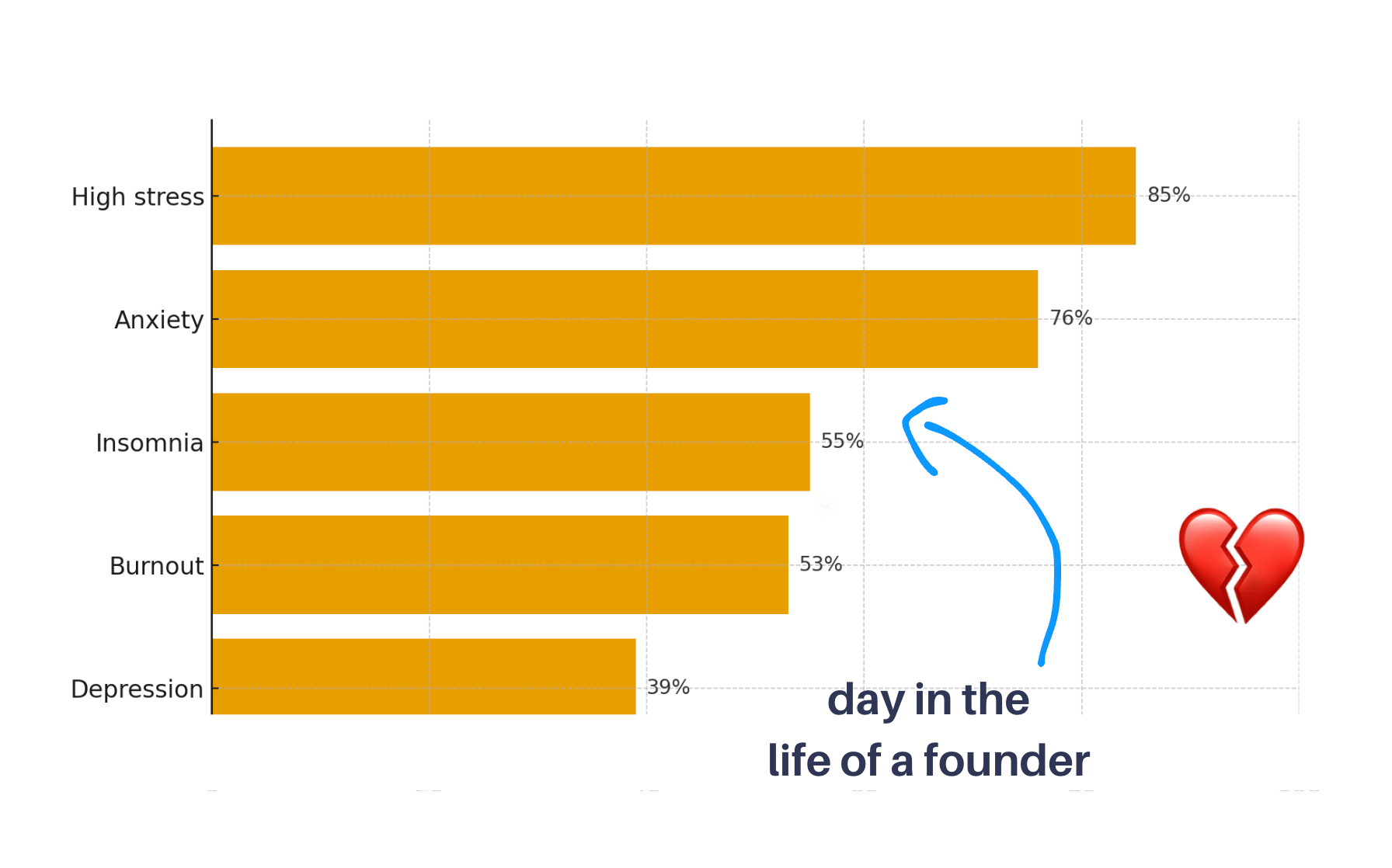
Burnout and hard work aren’t the same thing. Hard work doesn’t necessarily lead to burnout. Hard work is a necessary component; come on, you’re trying to do a startup, it’s really fucking hard. But when you up the ante on the stress, that’s when you’re likely to run into burnout.
Source: Sifted.
How can founders detach their self-worth from their startup?
There’s no one-size-fits-all framework. You really have to look at the individual. For example, if I were working with you, I might probe into the history of how you started Open Source and why. I might go back to your belief systems about money. If there is one thing, it’s the process I call radical self-inquiry. It’s really looking honestly in the mirror and asking: Why do I do what I do? Why do I drive myself this way?
All the things you mentioned: wellness routines, morning rituals, good sleep, exercise—they all help, and they’re important. But they’re not universally transformative. You can’t create real change just by applying routines. The work is deeper than that.
Should founders always see a psychologist?
Let’s broaden that question. I think everyone should create space to ask core questions of themselves. My infamous one is, “How have I been complicit in creating the conditions I say I don’t want?”
If you and your partner fight every Friday night because you’re exhausted, what’s really going on? Everyone needs to do that kind of self-examination to grow up.
How you do that—whether through therapy, self-study, books, podcasts, or conversations—doesn’t matter. What matters is that you do the work.
How important is financial security for founders?
That’s actually the first chapter of my first book, Reboot: How does my perception of money shape the decisions I’ve made?
So what you’re really asking is: Should an adult pursue some level of safety and security by amassing a certain amount of money so they can live out their life? A financial planner would say, ‘Sure, that’s a great idea if possible.
The coach in me says: Be careful. Because for some of us—and I put myself in this category back in my 30s—no amount of money in the world was enough to make me feel safe. So the real issue wasn’t money. The real issue was safety.
Sure, do you want to live what’s called the ‘life deferment plan,’ where you work like a dog in your twenties so you can surf the rest of your life? Fine, that’s a perfectly legitimate strategy. But if you’re neurotically attached to money as a means of stature, self-worth, or safety… good luck. The plan’s not going to work.
What daily practices keep you grounded?
When we talk about wellness in this regard, we’re really talking about the mystery and the myth of work–life balance. What you’re asking is: How do people find their way to mental and physical wellness? And it was interesting that you immediately shaped it as a weekly practice.
I would argue it’s actually something you need to practice on a daily basis. Every day I sit in meditation. Every day I journal. Every day I exercise. Every day I make sure I go out and see the sun. Every day I try to eat well and get good sleep. Don’t try to make this a weekly practice—try to make it an integrated daily practice.
More often than not, the impediment is people saying, ‘I don’t have the time.’ And that’s actually a function of prioritization, not a function of time.
What does a successful early-stage company look like?
Well, all the usual factors: a go-to-market strategy, a good product, strong product–market fit, a sales strategy that makes sense, a business model that makes sense, cash, the ability to have runway. I often use the metaphor that your job at that stage is to build the machine that makes the products and services. It’s not necessarily to build the products and services themselves.
So, a healthy company, one that’s breaking free of gravity, is a company that has a machine where, ideally, the culture celebrates innovation and risk-taking. People are having fun while the machine is getting built. That’s what I look for. I used to be a VC back in the day, and that’s what I would look for in a Series B or Series C company.
BRAIN FOOD 🧠

TOOLS WE RECOMMEND 🛠️
Every week, we highlight tools we like and those we actually use inside our business and give them an honest review. Today, we are highlighting Hyperbound*—the AI sales coach to help you quickly evolve and reinforce your playbooks as you scale.
 |
See the full set of tools we use inside of Athyna & Open Source CEO here.
HOW I CAN HELP 🥳
P.S. Want to work together?
Hiring global talent: If you’re hiring tech, business or ops talent and want to do it 80% less, check out my startup, Athyna. 🌏
See my tech stack: Find our suite of tools & resources for both this newsletter and Athyna here. 🧰
Reach an audience of tech leaders: Advertise with us if you want to get in front of founders, investors and leaders in tech. 👀
 |
Reply