- Open Source CEO by Bill Kerr
- Posts
- Dust Yourself Off & Try Again: Famous Founder Failures
Dust Yourself Off & Try Again: Famous Founder Failures
If at first you don't succeed, try, try again. ❤️🩹

Bill Kerr
January 04, 2026
👋 Howdy to the 1,356 new legends who joined this week! You are now part of a 228,630 strong tribe outperforming the competition together.
LATEST POSTS 📚
If you’re new, not yet a subscriber, or just plain missed it, here are some of our recent editions.
🪄 Dark & Full Of Terrors (2026 Predictions). Pulling out the crystal ball and taking a stab at what's to come.
🧶 Five Examples Of Founder Scrappiness. Examples of digging in when times are tough by some of the greats.
🎯 Leading Intercom’s AI Transformation. Des Traynor on zero-to-one mess, AI momentum, and leading with intent.

PARTNERS 💫
Framer is giving early-stage startups a full year of the Pro Plan—completely free.

Framer is the design-first web builder that helps startups launch fast. Join hundreds of YC founders already building on Framer. What you get with this deal:
Fast, professional site—no dev team needed. ✔️
Scales with your startup—from MVP to full site. ✔️
Spots are limited—apply before October 31st to claim your free year. *Pre-seed and seed-stage startups. New Framer users only.
Interested in sponsoring these emails? See our partnership options here.

HOUSEKEEPING 📨
Because my personal media diet seems to be a never-ending stream of negative news, I often escape by watching funny videos on YouTube, one of which I present to you below: the 100 funniest Red Bull soapbox crashes. I promise you it’s worth your time.
On a serious note, big hugs to all my Venezuelan readers. I have many friends in and outside of Venezuela, and I am thinking of you and yours today, and hoping that the events of the last 36 hours lead to a prosperous future for a sleeping giant of a country. Now, let’s dive into today’s post.

BUSINESS STORY 🗞️
Dust Yourself Off & Try Again: Famous Founder Failures
In the world of entrepreneurship, success is glorified, while failure is swept under the rug. The truth is, failure is an inevitable part of the journey to success. Many of the most successful entrepreneurs and business leaders we know and love today have experienced major failures before achieving their breakthroughs.
And while we sweep it under the rug—we shouldn’t. There is something about failure that we really get behind. Humans love an underdog story. David vs Goliath, LeBron James vs the 2016 Golden State Warriors, Rocky vs Ivan Drago. It takes courage to fail and try again.

“ADRIIIIAAANNN.”
But don’t take my word for it. Rocky Balboa said it himself: “It ain't about how hard you hit. It's about how hard you can get hit and keep moving forward.” Let’s dive in and take a look at some great leaders who took a knockout punch but climbed their way back up from the canvas.
Sir James Dyson & his 5217 failures
I’d like to get us started by highlighting a famous inventor, industrial designer, farmer, and entrepreneur who has failed more than most in history, Sir James Dyson of the Dyson company.
*And yes, this is the guy who invented that gross but somehow awesome hand dryer you use in every airport you visit through.

Credit: Stuart McClymont.
Dyson’s most famous invention is the ‘bagless vacuum cleaner’ using cyclonic separation, inspired by a sawmill that separated sawdust using centrifugal force.
But this story is about the science of suction; this is the story of a man who was determined to bring an idea to life—no matter how much the mischievous twins of failure and bewilderment wreaked havoc with his plans.
Supported by his wife's salary as an art teacher, it took Sir James thousands of attempts before he finally broke through.
I made 5,127 prototypes of my vacuum before I got it right. There were 5,126 failures. But I learned from each one. That's how I came up with a solution. So I don't mind failure. I've always thought that schoolchildren should be marked by the number of failures they've had. The child who tries strange things and experiences lots of failures to get there is probably more creative.
 The first Dyson, the DC01. |  No comment really. |
Before long, Dyson became synonymous with the industry and household goods, and he went on to create the Airblade hand dryer, bladeless Air Multiplier fans, the Supersonic hair dryer, the Corrale straightener, and many more products used worldwide today. Dyson’s net worth is estimated at over $13 billion dollars today.
The super pumped, Travis Kalanick
Travis Kalanick is often spoken of in the same breath as landlord-cum-billionaire Adam Neumann, for his ousting from Uber, the $172 billion dollar giant he co-founded. He has since done it again with the lesser-known CloudKitchens, which was most recently valued at $15B in 2021.

A polarising figure in tech.
But it’s not all been sunshine and UberEats for Travis. His first venture, Scour, filed for bankruptcy after a $250 million lawsuit from 33 of the world's largest media companies, and his second, Red Swoosh, faced financial difficulties before he co-founded Uber. A double failure, before two ginormous wins.
Fashion designer Vera Wang
American famous fashionista Vera Wang, best known for her elegant and sophisticated wedding dresses and haute couture collections, didn’t hit the ground running. Born in New York City in 1949 to Chinese immigrant parents, Wang spent most of her youth pursuing figure skating, aspiring to compete in the Olympics. Unfortunately, she bombed out of the 1968 U.S. Olympic team, leading her to transition to whatever came next.
 Young Vera. |  Design #1. |
Next for Vera was college, followed by an entry-level job at Vogue magazine. She rose to senior fashion editor, a position she held for 17 years, but was eventually overlooked for the editor-in-chief role in 1987. She resigned from Vogue to join Ralph Lauren as a design director, but it wasn’t until she turned 40 that she would start her own business. Thanks to that business, Vera today has a net worth of $250 million dollars.
Walt Disney
Walt Disney’s imagination and entrepreneurial spirit helped shape modern entertainment, but his early foray into business didn’t signal that he was the second coming of Jesus for creativity. Born in Chicago in 1901, Disney developed a love of animation from a young age. He founded Laugh-O-Gram Studios after a brief stint in advertising.

Walter Elias Disney.
Despite local buzz and a modicum of success in their retelling of famous fairy tales, Laugh-O-Gram filed for Chapter 11 bankruptcy in July 1923 due to ‘poor business management’. |  Little Red Riding Hood. |
Undaunted, Walt packed his bags for Hollywood, where he and his brother Roy founded Disney Brothers Studio. They would create Oswald the Lucky Rabbit shortly after, only to discover their distributor had taken ownership of the rights and the animators. Chalk that down as failure numero dos for the visionary Walt Disney.
The loss of Oswald led Disney to create a new character, Mickey Mouse, in 1928. The character’s popularity went crazy with the release of ‘Steamboat Willie,’ ushering in a new era of animated sound cartoons—as they were called at the time. The rest is history.
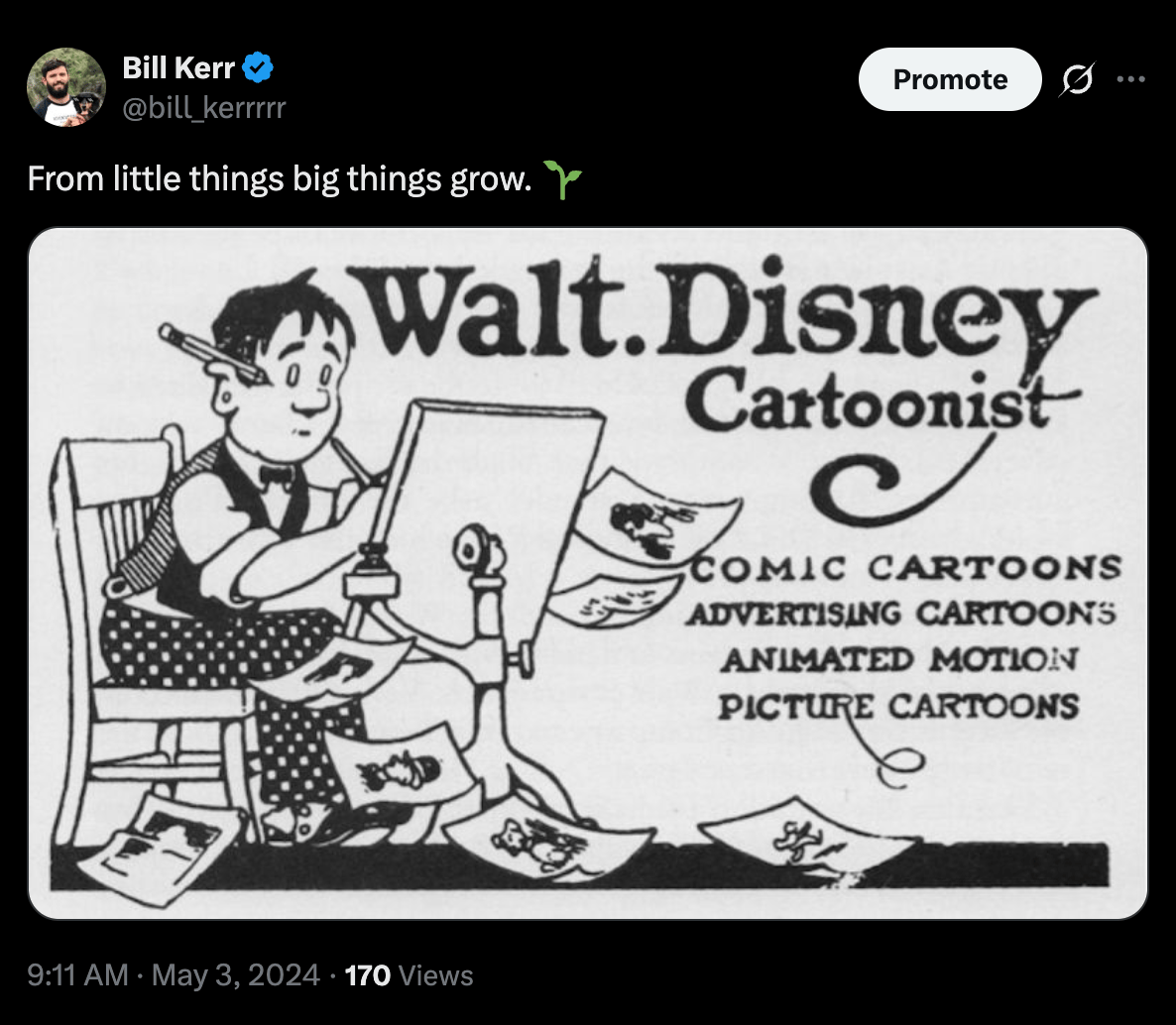
Disney went on to pioneer feature-length animation with ‘Snow White and the Seven Dwarfs,’ which revolutionised the industry, and helped Walt expand into television, theme parks, and live-action film, creating an empire now spanning Mickey Mouse to ESPN.
Bonus: The Disney flywheel
The business flywheel—more recently made famous by Jim Collins in ‘Good to Great’ and also in the content marketing of HubSpot—was also a focus for Walt. In the 1950s, years after his failed beginnings, Walt introduced a flywheel that created momentum across all his business assets.
Merchandise licensing fed into his parks, which in turn fed into his studio and theatrical films, which would then feed into music, TV, Marvel, Star Wars, and Ratatouille (ok, not these last few), and so on and so on.

The Disney flywheel.
It’s a powerful concept I have loved since I understood it, and this image shows the innovation and foresight Walt had in what he was building. Not all of these elements have stood the test of time, but most have.
Jack Ma of Alibaba
Jack Ma, the founder of Alibaba, had a difficult path to becoming one of China's most successful entrepreneurs. His story is a lesson in overcoming adversity. Ma was born in Hangzhou in 1964 and faced a mountain of rejections in his formative years.

Ma, far left.
After graduating from Hangzhou Teacher's Institute in 1988, Ma applied for countless jobs—including the infamous application at a local KFC—but was rejected from all of them.
I went for a job in the police department but they didn't consider me eligible. When KFC started in my city, I even went there. There were 24 applicants out of which 23 were recruited except me.
Eventually, he found work as an English teacher, earning a modest salary. His early entrepreneurial efforts also included a translation business and a failed directory called China Pages. |  83% sure this is legit. |
After founding Alibaba, he failed his bid for US expansion. He failed in a role-reversing takeover of Alibaba investor Yahoo when it hit leaner times. And he failed to make any logical sense a few years ago, when debating Tesla founder, Elon Musk.
As of May 2024, Alibaba has a market cap of ~$186 billion dollars, and Ma has a personal wealth of $25 billion.
Colonel Harland Sanders
Kentucky Fried Chicken (KFC) founder Colonel Harland Sanders—yep, real person/moustache—was a relentlessly determined character. Born in 1890 in Indiana, the Colonel had a tumultuous early career, working a slew of jobs such as a farmhand, insurance agent, and steam engine stoker (that sounds hard).
In the 1930s, he moved up in the world, running a small service station in Corbin, Kentucky, where he served homemade fried chicken to passersby. His unique blend of 11 herbs and spices was a major hit, leading to Sanders opening a restaurant and motel.

He look like your grandpa, or is it just me?
In the 1950s, though, disaster struck. Construction of a new interstate highway was set to bypass his restaurant, and the Colonel was forced to sell the property at a loss. Broke and living on a small pension, he drove across the country, pitching his fried chicken recipe to restaurant owners. He offered franchises in exchange for a small commission on each piece of chicken sold.
Over a thousand rejections later, he found his first partner and began building what became a franchise empire. By the 1960s, KFC was booming globally, and Sanders sold the business for $2M while remaining the company’s spokesman. Today, there are 25,000+ finger-licking good KFC outlets in more than 140 countries worldwide.
J.K. Rowling’s Chamber of Failures
Joanne Kathleen Rowling—or J.K.—began writing Harry Potter in the early 1990s while struggling as a single mother. Finding it tough to provide for her daughter, she wrote the manuscript for ‘Harry Potter and the Philosopher's Stone’ in cafes around Edinburgh, famously using her daughter’s nap time to build out her wizarding world.
 Author of the year. |  In simpler times. |
After finishing the book, Rowling sent the manuscript to 12 different publishers and faced rejection from each and every one. Finally, Bloomsbury Publishing agreed to publish the book, influenced by the publisher’s young daughter, who loved the story. Despite an initial print run of only 500 copies, the book quickly gained traction, and Harry Potter became the cultural phenomenon we know today, selling 500 million copies, and leading to films, merchandise, theme parks, and a soon-to-be-released HBO series.
Q: Are 2nd-time founders actually more successful?
While preparing for this piece, I took a little look into the data around second-time founders and whether they are, in fact, more likely to succeed. To be honest, what I found (hard to find good data on it, this is ancient) was conclusive, but not stark. Here is what we found:
First-time small business owners have a success rate of 18%.
Business owners who failed in the past have a slightly higher startup success rate of 20%.
Business owners who started a successful startup in the past have a business success rate of around 30% when starting a new venture.
To be honest, I was a little underwhelmed. We have been told to learn from our mistakes and come back bigger and better. ‘What doesn’t kill us only makes us stronger, right?‘ Well, the data does indeed back that up—but 2%?
I found the data I expected to see in a chat with Anthropic’s Claude, but the problem is that it refused to give me sources, and after tireless searching, I finished with the stance that this was actually a hallucination.

Cheers, Claude.
The hunt for more data really did turn up dry. The debate was raging on Reddit a couple of years ago, and I also found the same discussion on Hacker News all the way back in 2008.

Advanced maths x 1 trillion.
If it is, in fact, 2% benefit from all the learning you have from your first failures, then it is still meaningful. In business, every day is a fight until your dying breath, so if you can scratch and claw your way to a couple of extra basis points, you’d take it.
Bill Gates and Traf-O-Data
The man synonymous with Windows 95 and the most significant software launch in living history, Bill Gates, also failed at his first startup venture. Yes, sure, he was 17 years old chronologically and 12 years old visually—but a failure is a failure.

Bill Gates & Paul Allen, Lakeside School, 1970.
In 1972, while still in high school, Bill Gates and Paul Allen created a traffic data analysis system called Traf-O-Data, intending to provide traffic data processing services. They had a decent idea, but the business struggled due to technical issues processing raw traffic data using early microprocessor technology. They also had market challenges.
It seems municipal governments—their primary target—weren’t as interested in outsourcing traffic data as expected. The failure taught Gates lessons about market and customer needs, which he applied when founding Microsoft, the most valuable company in the world today. |  Traf-O-Data. |
And another Bill, me
The least famous example from our list today, is me, and my first startup AdventureFit. We took people all around the world on adventure holidays. We trained, hiked, and climbed our way all across the globe. All while drinking a few beers, enjoying a burger or two, and having as much fun as humanly possible.

Base Camp, circa 2017.
Like most of our entrepreneurs and their failures, I thought I was building the greatest company in the world. But as Ernest Hemingway said in The Sun Also Rises, “How did you go bankrupt? Two ways. Gradually, then suddenly.”
I remember the moment I asked my team what they thought we should do moving forward, sometime in our fifth and final year of operations. They told me the truth; we should shut it down. The moment I got out of the meeting, I cried my little founder eyes out for a few minutes, then took a few deep breaths and moved on with my life.
And a load more famous failures
Milton Hershey: Experienced two failed candy businesses before perfecting a caramel recipe and finding success with Hershey’s chocolate.
Brewster Kahle: After the fall of his early company, Thinking Machines, his WAIS technology was commercially unsuccessful before he founded the Internet Archive.
Stephen King: Faced numerous rejections for his early work, and his first major novel, ‘Carrie,’ was initially discarded before being saved by his wife.
Sylvester Stallone: Struggled to find acting opportunities and lived in poverty before writing and starring in ‘Rocky,’ which became an international hit.
Abraham Lincoln: Lost multiple elections and faced early business setbacks before eventually becoming president and leading the nation through the Civil War.
Winston Churchill: After the Gallipoli disaster, he was sidelined politically and faced public criticism before returning to lead the UK through World War II.
Summary
The idea of this piece was not to tell you that if you try and fail, you’ll learn, and you’ll learn, and you’ll eventually inevitably be successful. No—the idea was to highlight the fact that we fail. We all do, for to fail is to be human.
But in that failure, there is hope. Hope that maybe, just maybe, we can be the one that finally breaks through. I leave you with this quote from His Airness, Michael Jordan.
I’ve missed more than 9,000 shots in my career. I’ve lost almost 300 games. Twenty-six times I’ve been trusted to take the game-winning shot and missed. I’ve failed over and over and over again in my life. And that is why I succeed.
Further study
The Four Types Of Managers & How To Manage Them - March, 2025
The Negative CAC Media Pyramid - March, 2025
Strategism: How Companies Are Owning Emojis - May, 2025
And that's it! You can follow me on Twitter and LinkedIn, and also don’t forget to check out Athyna while you’re at it.
BRAIN FOOD 🧠
TOOLS WE RECOMMEND 🛠️
Every week, we highlight tools we like and those we actually use inside our business and give them an honest review. Today, we are highlighting Hyperbound*—the AI sales coach to help you quickly evolve and reinforce your playbooks as you scale.

See the full set of tools we use inside of Athyna & Open Source CEO here.
HOW I CAN HELP 🥳
P.S. Want to work together?
Hiring global talent: If you’re hiring tech, business or ops talent and want to do it 80% less, check out my startup, Athyna. 🌏
See my tech stack: Find our suite of tools & resources for both this newsletter and Athyna here. 🧰
Reach an audience of tech leaders: Advertise with us if you want to get in front of founders, investors and leaders in tech. 👀
 |
Reply