- Open Source CEO by Bill Kerr
- Posts
- AI Agents & The New Developer Workflow
AI Agents & The New Developer Workflow
An interview with Zach Lloyd, Founder & CEO at Warp. ⚡️

Bill Kerr
January 11, 2026

👋 Howdy to the 1,697 new legends who joined this week! You are now part of a 233,302 strong tribe outperforming the competition together.
LATEST POSTS 📚
If you’re new, not yet a subscriber, or just plain missed it, here are some of our recent editions.
🎱 Ship Faster: AI Review & Crafting The Culture. An interview with Merrill Lutsky, Co-Founder & CEO at Graphite.
🌱 Collection: Getting The Best Out Of Yourself. A collection of thoughts from a collection of leaders.
❤️🩹 Dust Yourself Off & Try Again: Famous Founder Failures. If at first you don't succeed, try, try again.

PARTNERS 💫
Always-on brand tracking, minus the scary price tag.

When brand data is always-on, decisions get easier to defend.
Tracksuit helps marketers and agencies track brand health continuously, without the heavyweight price tag.
Teams get an up-to-date view of funnel performance, clear benchmarks, and evidence of impact after campaigns launch – turning brand building into something leadership can trust.
The result? Smarter spend, stronger data-confidence and brand work that translates into commercial goals.
Interested in sponsoring these emails? See our partnership options here.

HOUSEKEEPING 📨
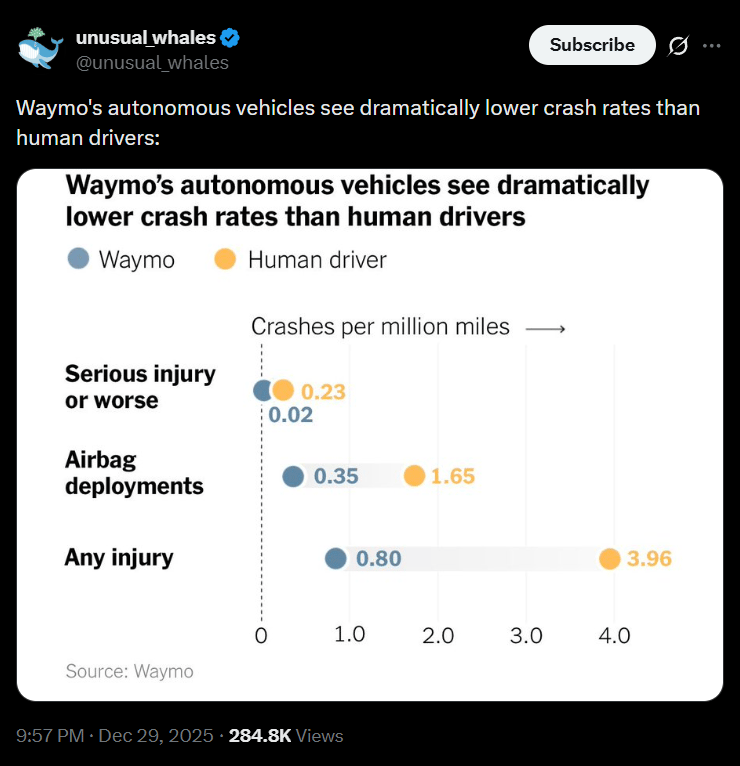
I saw this chart on Twitter and found it fascinating. It made me think of the recent interview by U.S. political pundit Tucker Carlson with the famous Brit, Piers Morgan. Throughout the interview, Tucker kept telling Piers how dangerous London was and how immigrants had ruined the city, to which Piers continually replied with (paraphrasing) “I don’t agree.” I put it down to brainrot on Tucker’s part at the time, but placing it alongside the data below is more aptly defined as ‘algorhythmically induced catastrophism.’
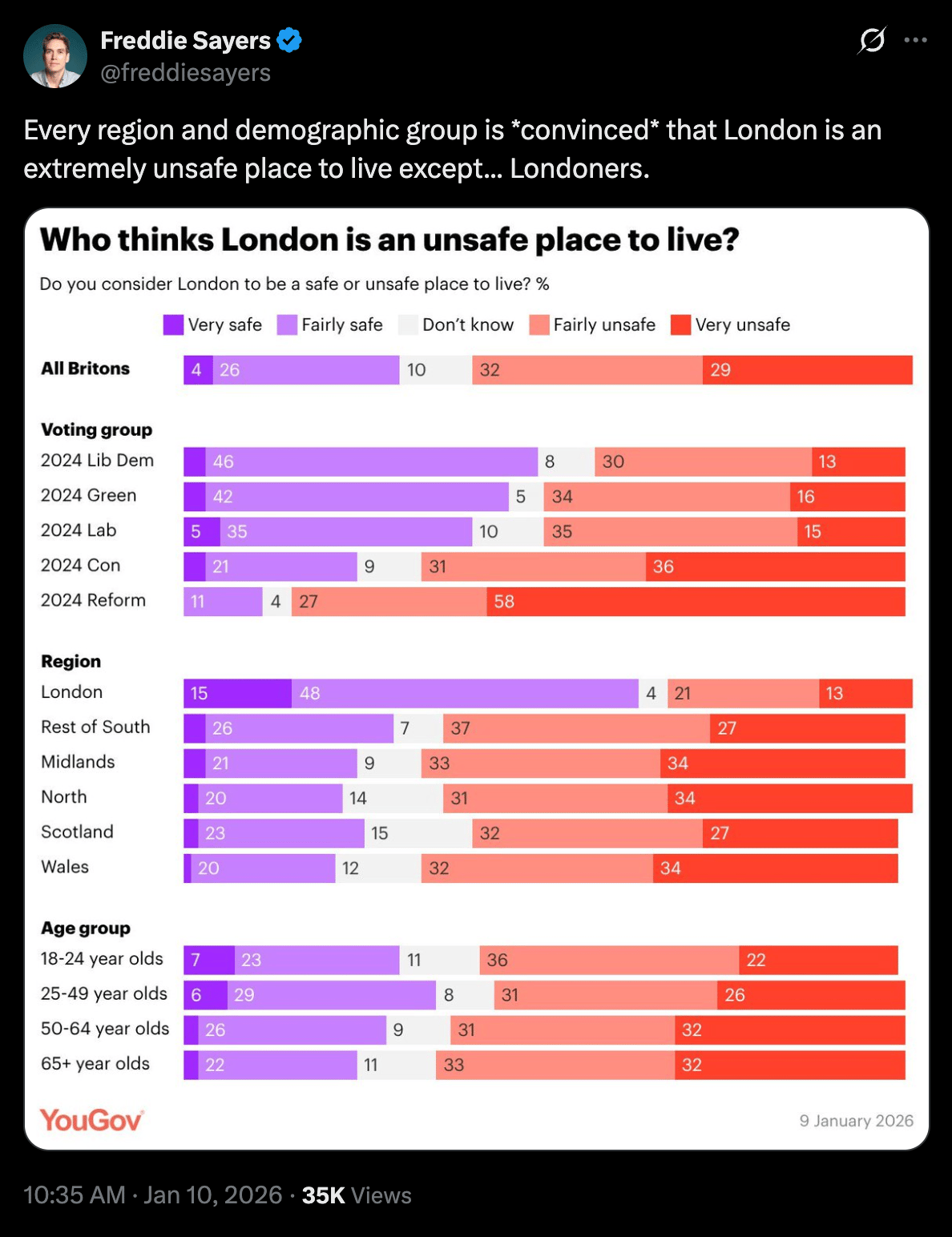
After the Bondi shooting recently, I had an American friend ask me how dangerous Australia had become because of radical Islam, to which I replied, “I’ve not thought about it once in my life. I’ve felt safe 100% of the time I’m in Australia, always have.” Maybe I spend too much time online myself at the moment, but all I see in the West (US, Australia, UK) is unfounded racism and a negativity pointed firmly inwards. I still think Australia is probably the greatest country in the world, but I find it very difficult to enjoy Australia culturally speaking in 2026.

INTERVIEW 🎙️
Zach Lloyd, Founder & CEO at Warp
Zach Lloyd is the Founder and CEO at Warp, a next-generation developer terminal and agentic development environment backed by more than $70 million in venture funding. Before starting Warp, he served as a principal engineer at Google, where he led the Google Docs initiative, and later held the role of Interim CTO at TIME.
Lloyd’s mission with Warp is rooted in a belief that developers deserve tools as modern, powerful, and intuitive as the apps they build. He chose to revisit the terminal—a long-standing developer interface that had seen little fundamental innovation—and rebuild it from first principles to support speed, collaboration, and AI-driven workflows. His leadership emphasizes dogfooding the product internally (he writes code using the terminal and prompts the agents himself), and he actively shapes company culture, engineering habits, and growth metrics around making the developer experience radically better.

What problem are you trying to solve, and why?
The problem I am focused on is helping professional developers ship better software more quickly. More specifically, we are using AI and agents inside the terminal to help developers build and deliver faster.
I care about this problem because I have spent my career trying to create impactful software, so building a tool that helps others do that feels meaningful. It is also a huge economic opportunity since improving the quality and output of software at scale creates a massive amount of value.
What was the most difficult part of going from zero to one?
The hardest part of going from zero to one is figuring out whether people actually want what you are building. There is always a risk that you are the only person who cares about the idea. I believed this product should exist, but most startups fail at this stage because they build something users do not truly need.
For us, the challenge was shaping the product so it solved a real, important problem. Getting that fit right was both the most interesting and the most difficult part of the early journey.
How do you prepare the company to grow fast, and what changes?
The key is getting the foundation right. That means being intentional about culture from day one, setting up strong product processes, and bringing in people who can scale with the company as demand grows. Those early choices matter a lot once things start moving quickly.
What changes is the level of urgency. Before fast growth, you have more time to perfect things and follow your ideal process. Once the company is scaling, you have to get comfortable with some mess. You learn to prioritize the top problem and let certain things sit for a while because you cannot fix everything at once.
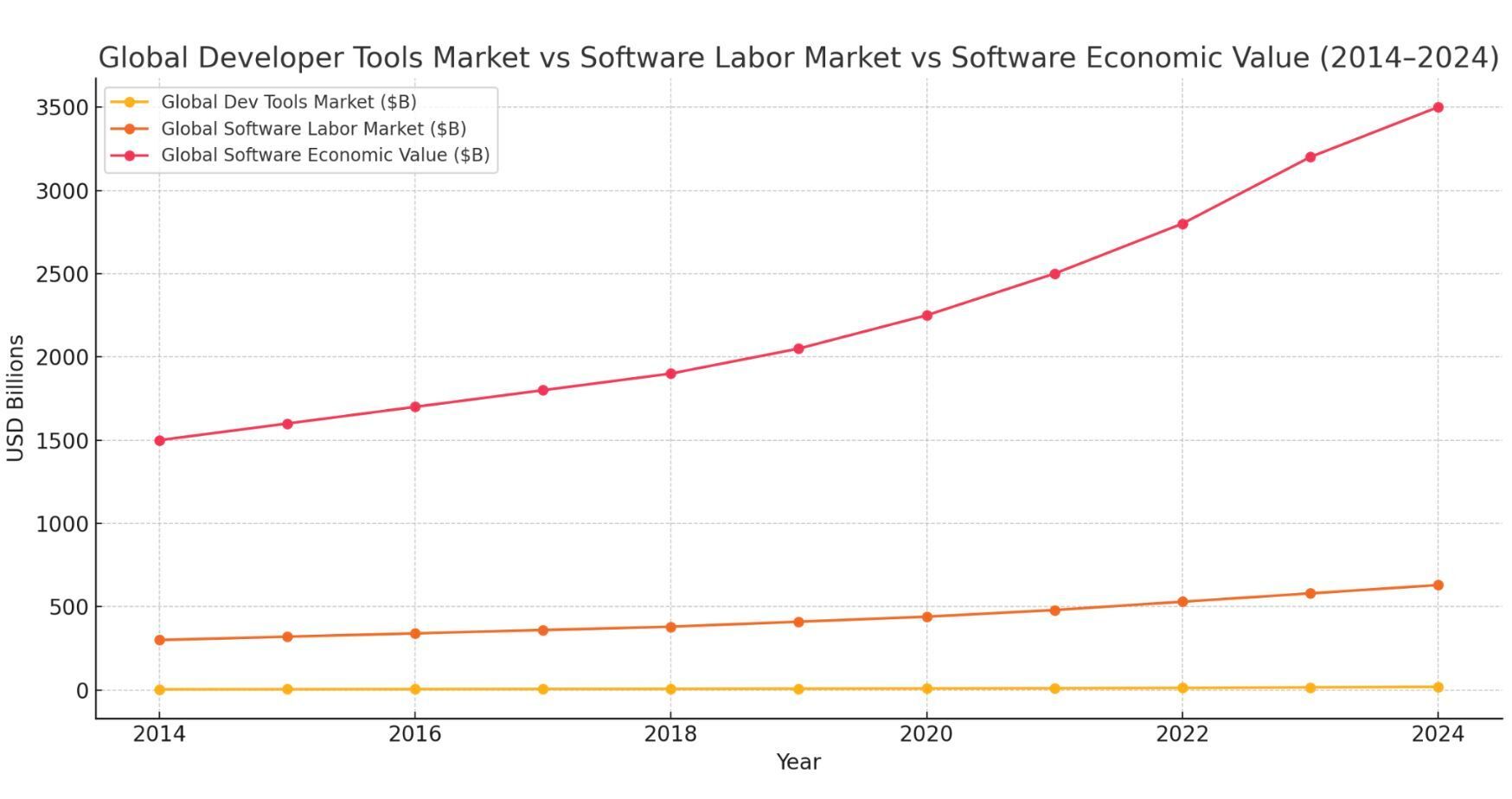
Source: OpenAI deep research.
What is your day-to-day job as CEO?
One of the great parts of being a founder CEO at an early company is that I get to do a bit of everything. What I focus on shifts based on what the company needs. Recently, I have been doing a lot of outward-facing work like podcasts, panels, and helping with sales. I also spend time shaping the product roadmap and vision.
Some days, I even write code or use the product myself. Overall, I look at each day through the lens of where I can have the most impact and do the most to increase the company’s chances of succeeding. What that looks like changes as the company grows and evolves.

What does your team look like, and who are your direct reports?
We are a very technical company, so most of the team is in product, engineering, or design. In fact, the majority is engineering, which makes sense given how technical our product is. We keep the structure fairly flat, but I do have a few key leaders who run major functions.
My direct reports include our Head of Engineering, our Head of Growth, and our Head of Sales. I trust them to manage their teams and handle people management.

Because we are growing quickly and things can get messy, I also have a few people from other functions reporting to me for now. We are working on making that structure more efficient as we scale.
How do you hire all-star talent?
Hiring great talent has to be a top priority from the very beginning. We treated it that way and even brought a recruiter in-house when we had fewer than ten employees. We put a lot of effort into sharing our mission, culture, and product thinking publicly so high-caliber people would be excited to join Warp.
The other big piece is making sure the first hires are exceptional. Great people want to work with other great people, so once you get a few strong early team members in place, it becomes much easier to attract more. That early foundation sets the tone for the entire company. |  |
What is your philosophy around leadership?
My approach to leadership starts with empathy. I think about what I would want from a leader if I were in someone else’s shoes. The qualities that matter to me are having a clear vision, being decisive, being honest and transparent, being able to make hard choices, and being willing to listen. Humility is important too.
Those traits are what I have seen in the best leaders I have worked with, so I try to embody them for my own team. My goal is to create the kind of leadership experience that I would personally want to follow.
What is your North Star metric at Warp?
Our main North Star is active developers who actually use Warp in their day-to-day work. If we can genuinely help people build software faster and with fewer headaches, that is the truest sign we are delivering real value. That number has been doubling every year, which has been a strong validation for us.

We also pay close attention to revenue. It is one thing for developers to try the product, but it is another for teams to adopt it and pay for it at scale. In the last year especially, revenue growth and retention have become important signals that we are building something durable. So we keep the focus tight: active users and ARR growth.
How do you build culture?
Culture happens no matter what, so I try to shape it instead of letting it form by accident. Before I even started Warp, I wrote down what mattered most to me: our values, how we communicate, how we build products, and the principles that guide our decisions. Making all of that public helped attract people who naturally resonate with it, which means the culture starts forming even before someone joins the team.

Inside the company, we treat culture almost like a living product. We try to embody the values we publish, and we adjust them as the company evolves. A good example is how we changed our planning process once growth really accelerated. The quarterly OKR structure was slowing us down, so we shifted to weekly company-wide prioritization. We documented it, shared it, and made it part of how we operate. That kind of continuous adjustment keeps the culture healthy as we scale.
Can you share an example of how your operating principles changed?
One clear example is how we changed our planning process. Early on, we used a more traditional quarterly OKR system. It was structured, it was thorough, and it fit the pace we were moving at in the beginning. But as the company grew and the market became more competitive, that approach started to slow us down. We needed to move faster.
So we shifted to a weekly, company-wide prioritization rhythm. We still keep a long-term direction, but every week we look at what matters most and adjust our focus accordingly. It helps us respond to real conditions instead of sticking to a plan that no longer matches reality. And because culture is something we try to document transparently, we updated our internal “how we work” guide so the entire team sees the change and understands the why behind it.
Who is your ideal customer profile, and how do you identify them?
Our ideal customer is a professional developer who uses Warp for real, economically important work. We are focused on the environments where the most valuable software in the world is being built, which usually means established companies or fast-moving startups. Those teams have complex codebases, real production systems, and a lot to lose if things break, so the productivity gains really matter.

We identify them by looking for developers who live in the terminal and rely on it every day. These are people who care about speed, reliability, and collaboration because their work directly impacts the business. Warp is a very technical tool, so it shines the most when it is used by people building serious, high-impact software rather than hobby projects or casual tinkering.
How are you using AI operationally in the company?
The simplest way to put it is that we use Warp to build Warp. Every software developer at the company starts their work through a prompt in our own product, whether they are writing new code, fixing a bug, or investigating an issue. The agent inside Warp helps break down the task, generate code, and guide the workflow.
It creates a great feedback loop. As the product improves, our engineering speed improves, which then gives us more insight into how to make the product even better. It is a very tight cycle, and it pushes us to build features that are genuinely useful because we rely on them every day. |  |
How do you get the best out of yourself personally and professionally?
Right now, my life is centered around two things: building the company and being present for my young son. Those two roles balance each other in a way that keeps me grounded. When I am working, I am fully focused on pushing Warp forward. When I step away, spending time with him gives me perspective on why I am working so hard in the first place.
That balance helps me stay motivated and avoid getting lost in the constant pressure of startup life. It reminds me of the bigger picture. Professionally, it keeps me sharp because I come back to work with a clearer head. Personally, it forces me to slow down and actually be present, which I think makes me better at both parts of my life.
Do you have any winding-down practices to help you be more present?
The biggest anchor in my day is my son’s evening routine. No matter what is happening at work, I try to be there for dinner, bath time, reading a book, and putting him down.
It creates a natural break in the day where my attention shifts completely. I am not perfect at it, but I try hard to avoid checking Slack or email during that window. Having that predictable, hands-on time with him pulls me out of work mode and into something slower and more intentional. It is the most reliable way I have found to reset and be present. |  Attached to what matters. |
BRAIN FOOD 🧠

TOOLS WE RECOMMEND 🛠️
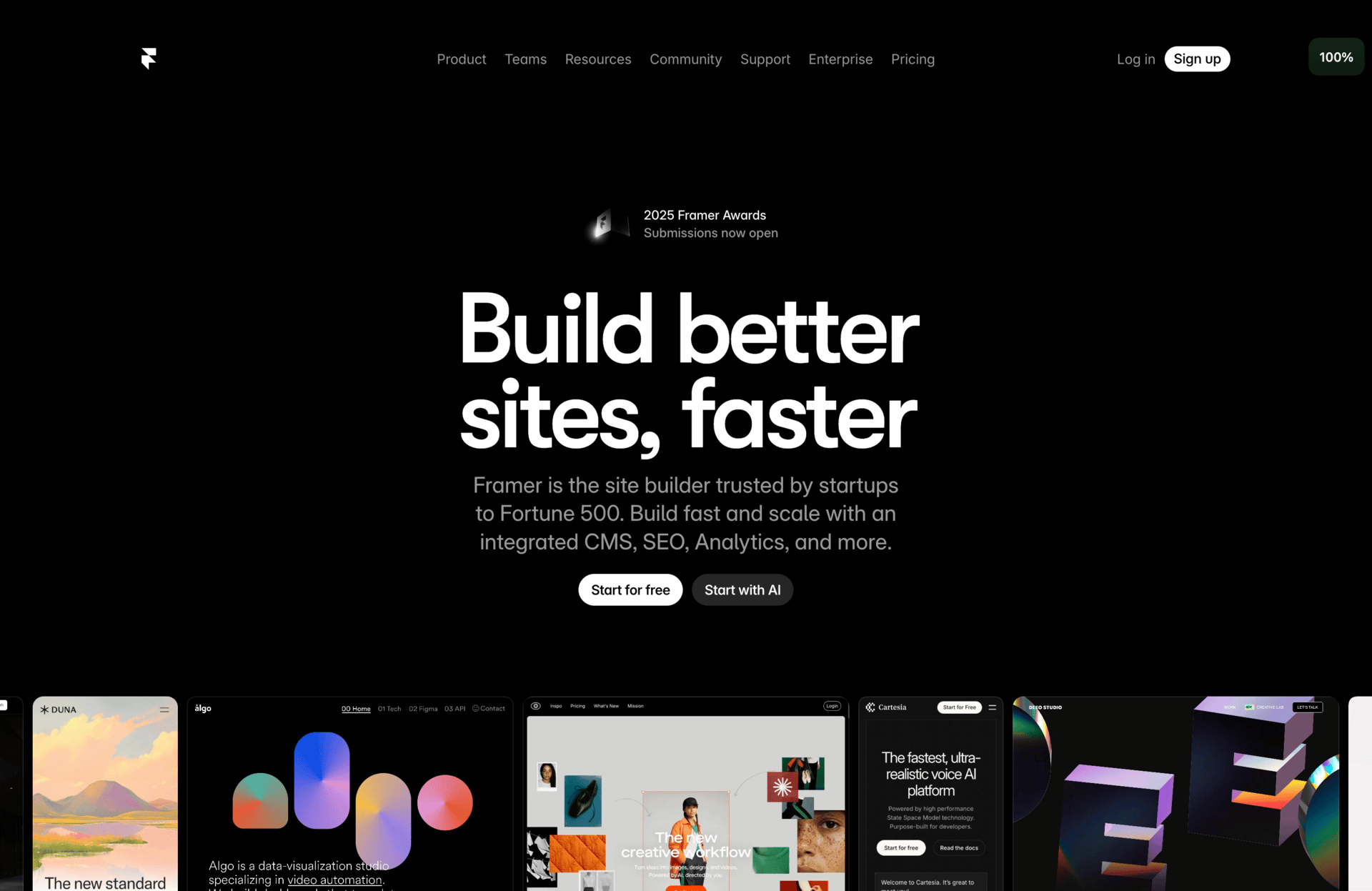
Every week, we highlight tools we like and those we actually use inside our business and give them an honest review. Today, we are highlighting Framer*—the site builder trusted by startups to Fortune 500.
See the full set of tools we use inside of Athyna & Open Source CEO here.
HOW I CAN HELP 🥳
P.S. Want to work together?
Hiring global talent: If you’re hiring tech, business or ops talent and want to do it 80% less, check out my startup, Athyna. 🌏
See my tech stack: Find our suite of tools & resources for both this newsletter and Athyna here. 🧰
Reach an audience of tech leaders: Advertise with us if you want to get in front of founders, investors and leaders in tech. 👀
 |
Reply